
Executive Summary & Key Takeaways
The problem, in one line:every team's ads pointed at that team's own number, and once a chat opened, whatever happened next — which counselor handled it, whether it became a sale — never connected back to the ad that started it, or to any other team's numbers, or to the CRM record that eventually captured the outcome.
Counselors already logged outcomes in a CRM, or for smaller teams a shared spreadsheet, as part of their normal job. What didn't exist was a link between that record and the ad, team and number that had produced the lead — so a student who inquired with the bootcamp team in March and enrolled through the study-abroad team in September looked, in the data, like two unrelated people.
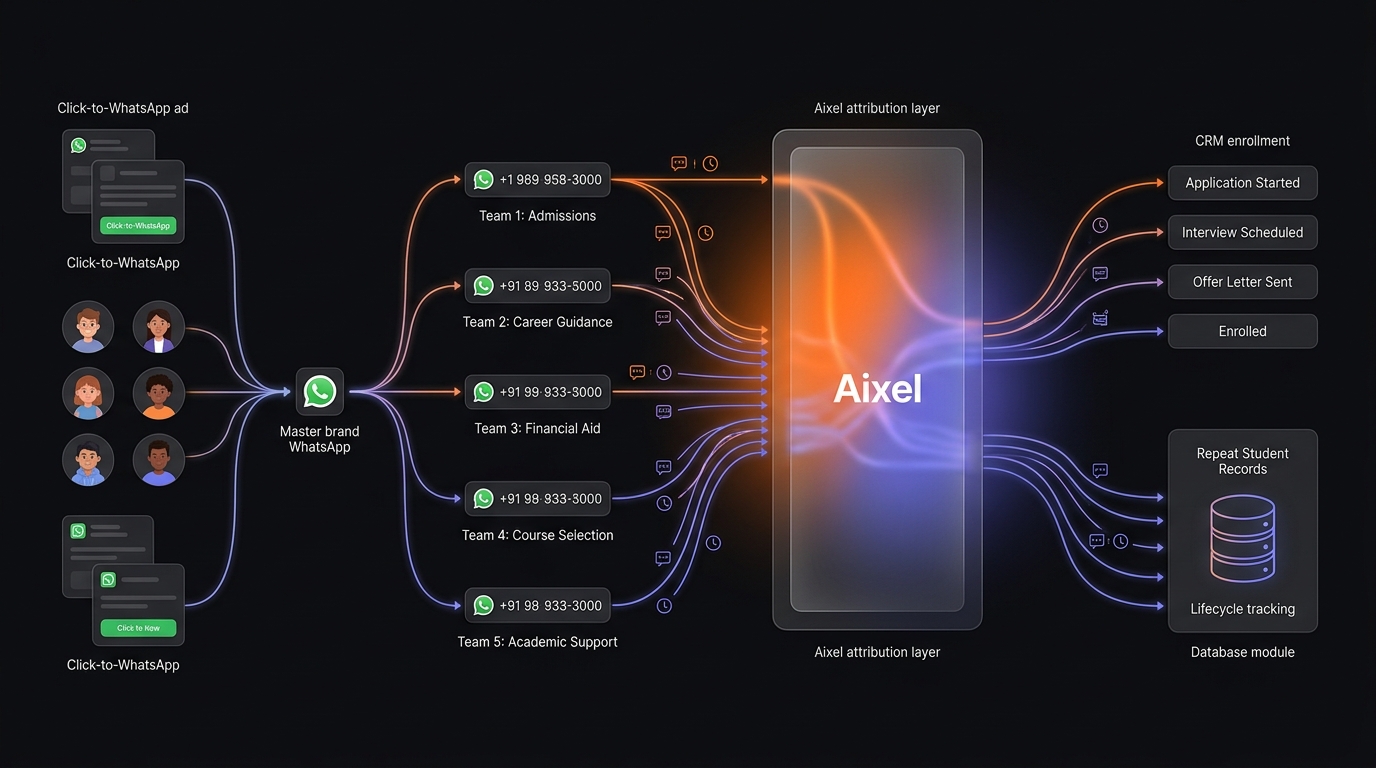
- The Fix: Aixel connected the master number and every team's number into one measurement layer, captured which ad started each chat automatically, and linked that source back to whatever the CRM or sheet already recorded as the outcome.
- Cross-Team Funnel Tracking: Tracked each lead's stage across every handoff — including across teams — linking repeat enrollments and illuminating multi-touch attribution.
- Real Outcomes: The result was better team efficiency, improved lead quality, and lower customer acquisition cost (CAC), without changing how any team already worked its number or forcing a CRM migration.
An EdTech company sold half a dozen programs — IELTS prep, spoken English, a data analytics bootcamp, a digital marketing certificate, study-abroad counseling — through a structure that's common at real scale: one master WhatsApp number for the brand itself, and five product teams, each running its own Click-to-WhatsApp campaigns against its own dedicated number. Three to five counselors sat behind each team number — around twenty people in total.
That's a sensible way to run a counseling operation. It's also why almost nothing about what actually happened was visible to the business as a whole.
About the customer
The customer sells short-format programs — test prep, professional certificates, study-abroad counseling — through counseling teams rather than self-serve checkout. Each program is sold by its own team, each team runs its own Click-to-WhatsApp ads, and each team has its own number. A master brand number sits above all of it, catching direct and organic inquiries that never came through a team's ads at all.
This shape — one brand-level number, several product-team numbers underneath it — is what a WhatsApp-led sales operation looks like once it grows past a handful of people. It also breaks standard ad attribution six different ways at once, one for every number. (To understand how multi-channel fragmentation causes blind spots, see our guide on why marketing attribution breaks across Meta, Google, TikTok, CRM, and WhatsApp.)
The problem
Three things were broken, and they compounded each other.
1. The numbers didn't talk to each other
Six numbers — the master number and five team numbers — each ran their own WhatsApp Business app with their own chat history and their own counselors. There was no single place to see the IELTS team's numbers next to the bootcamp team's, let alone against the master number's organic inquiries. Within a team, the ad pointed at a shared number, and whichever counselor was free picked up the chat — so even inside one team, nobody could see who had actually closed a given lead.
2. The ad source never reached the CRM
Counselors logged outcomes in a CRM or spreadsheet as part of their normal workflow. That record just had no link back to the ad, team or number that had produced the lead. The connection existed only in a counselor's memory, if anywhere.
3. Journeys crossed numbers, and nobody could tell
A student might inquire with one team, go quiet, and message a different team's number months later after seeing a different ad — or start at the master number and only reach a specific team weeks after that. Every touchpoint sat on a different number. Reconstructing that journey by hand, across six numbers and twenty counselors, wasn't realistic — and without it, nobody could say which teams actually drove repeat enrollments, which counselors converted best, or where each team's funnel leaked.
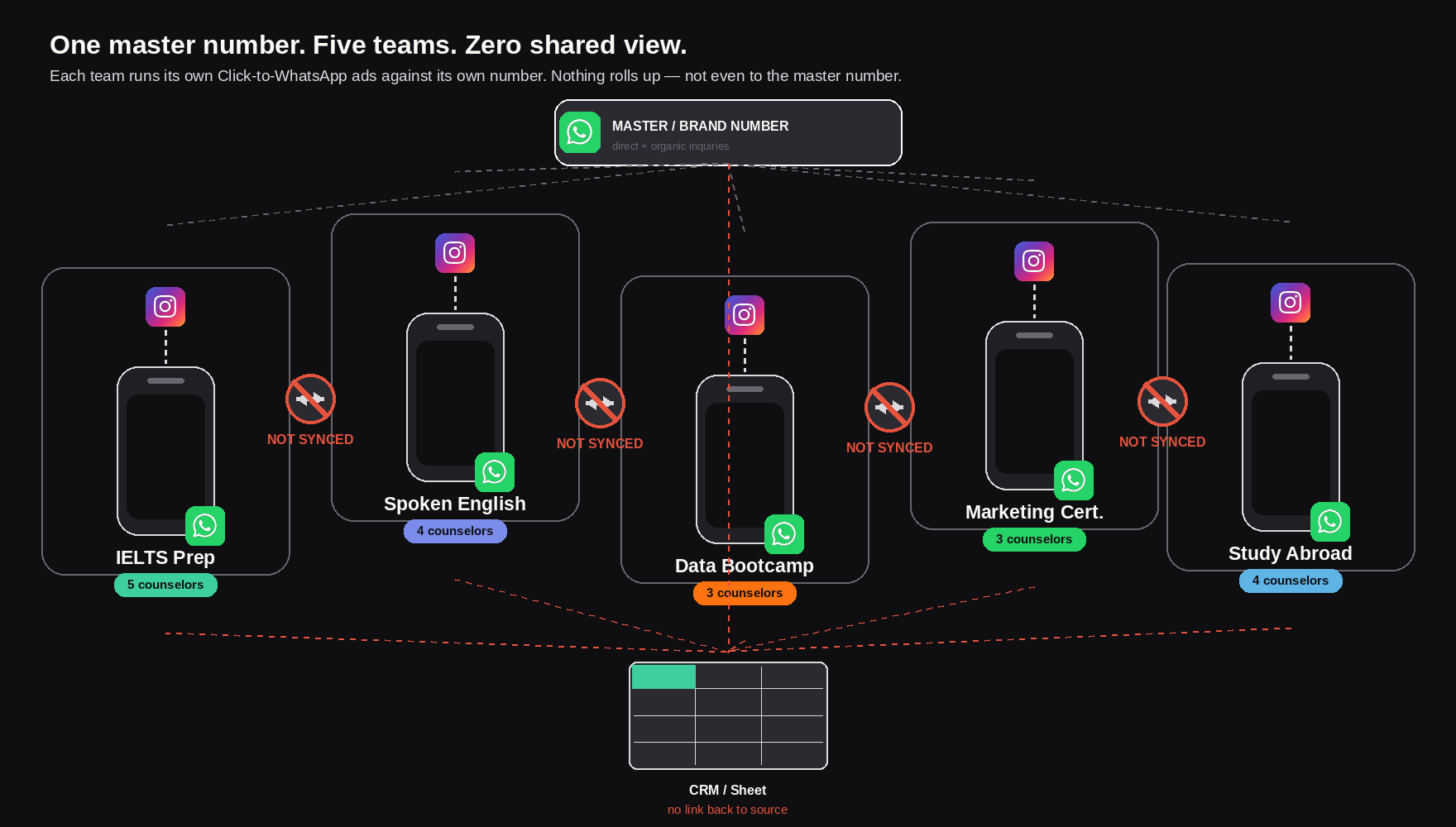
One master number, five product-team numbers, roughly twenty counselors — and nothing connecting any of it.
Why this needed a different measurement design
One number, one team — that's already hard to attribute correctly. A master number sitting above five product teams multiplies the same problem by six, and adds a new one: journeys that cross team boundaries have no structural way to be recognized as the same customer. Standard pixel-and-checkout attribution assumes one event on one system. This was six numbers, cross-team handoffs, and a CRM that only ever saw the last piece of the story.
As we covered when exploring how WhatsApp is often the actual sales floor, reporting the conversion outcome is only half the battle; preserving the underlying identity across the entire multi-touch conversation is what separates actionable marketing intelligence from disconnected spreadsheets.
The Aixel solution
1. Connect every number in the hierarchy
The master brand number and all five team numbers, exactly as they were already set up and already advertised, into a single measurement layer. No renumbering, no migration.
2. Capture the Click-to-WhatsApp signal automatically, on any number
The instant a chat opened from an ad — on any team's number — Aixel captured which ad, creative and campaign had started it (via exact click tokens like ctwa_clid as detailed in our WhatsApp Conversions API guide). Chats that arrived on the master number with no ad behind them were marked organic instead of left unexplained.
3. Link each ad and team to whatever the CRM or sheet already recorded
Aixel connected the outcome each counselor already logged — in whichever CRM or spreadsheet their team used — back to the ad, team, counselor and number that had produced the lead. Counselors kept working exactly as before; the missing piece was the link back to source, not the logging itself.
4. Track funnel stage across every touchpoint, including across teams
Each lead moved through Inquiry → Qualified → Counseling Call Scheduled → Enrolled → Repeat Enrollment, followed as one continuous journey even when it crossed counselors, team numbers, or the master number.
5. Link enrollment back to source — including repeat students who return through a different team
A bootcamp graduate who came back through the study-abroad team's number six months later got connected to their original record, making cross-team repeat patterns visible for the first time. And because each team's ads already map to one product, team-level reporting came from that structure directly — no need to read chat content to know a lead was about the bootcamp.
6. Feed marketing signals back to Meta, broken out per team
Each team's campaigns started receiving their own qualified-lead, call-scheduled and enrolled signals through the WhatsApp Conversions API, so every product line could optimize against its own real outcomes instead of one blended number for the whole business.
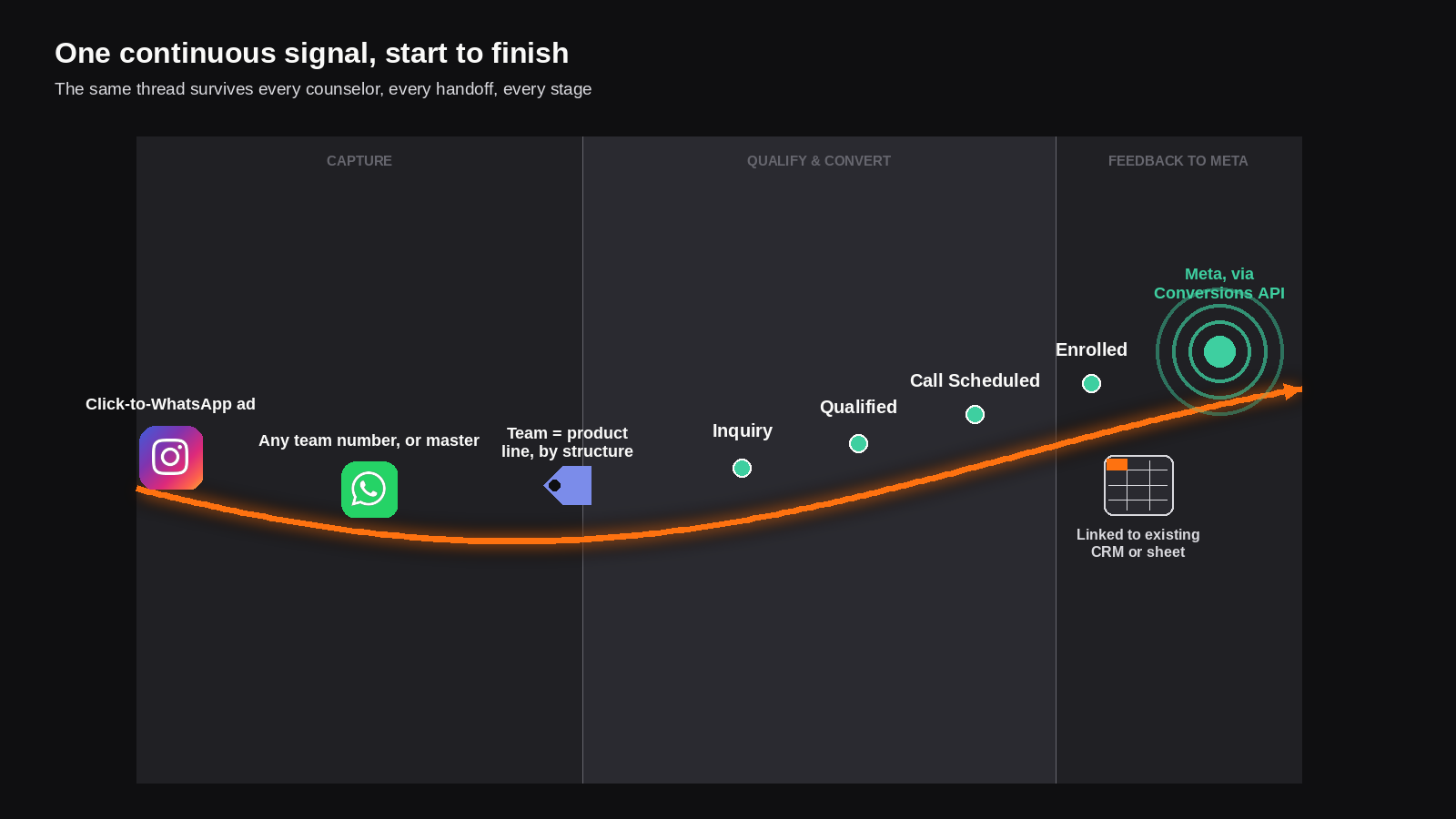
One continuous signal, start to finish — the same thread survives every team, every handoff, every stage.
The pipeline
Click-to-WhatsApp ad click → team number, or the master number for organic inquiries → automatic capture, no manual step → linked to the CRM or sheet the team already used → funnel stage, tracked across every handoff → Conversions API feedback to Meta, per team. This is precisely the architecture we outline across our Unified Measurement Layer guide.
The outcome
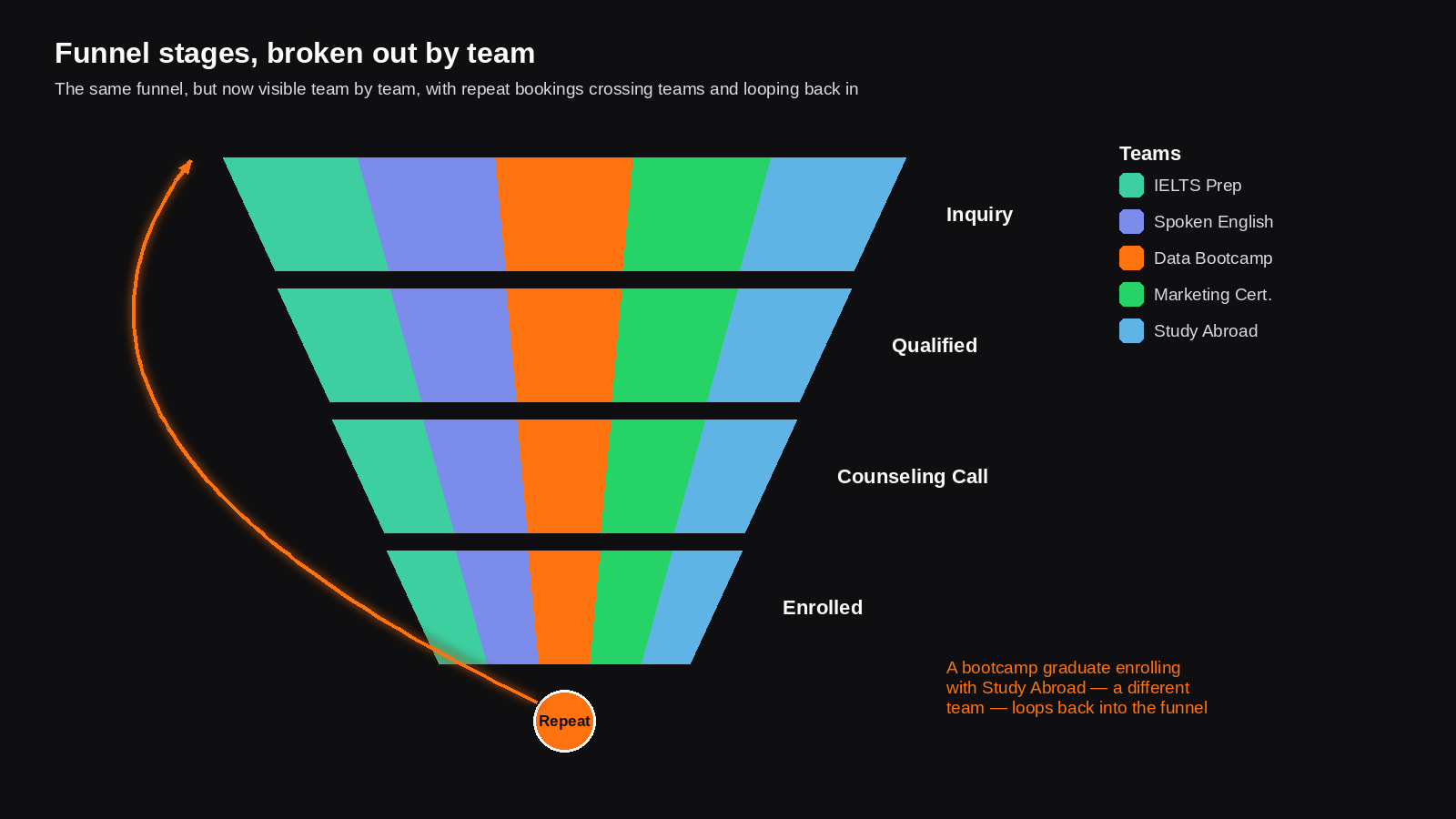
Funnel stages broken out by team, with repeat bookings — across teams — looping back into the top.
The trail stopped depending on memory
A lead's path from ad to outcome stayed intact across counselors, teams, and the master number, instead of relying on someone remembering which ad started it months earlier.
Cross-team repeat patterns became visible
A student enrolling with one team after an earlier inquiry or enrollment with a different team was recognized as the same person — something no single team could see on its own.
Team-level performance became visible
The business could compare team against team: which teams produced the most repeat students, which counselors converted best, and where each team's funnel actually leaked.
Lead quality improved
Each team's campaigns started optimizing against its own accurate, stage-by-stage signal instead of one blended “chat started” number for the whole business.
Team efficiency improved
Counselors kept logging outcomes exactly as before; what disappeared was the separate work of trying to reconstruct which ad or team a lead had originally come from.
CAC came down
With every team's campaigns optimizing against real outcomes instead of raw chat volume, spend shifted toward the ads and teams that actually produced enrollments. (No specific percentage or revenue figure is disclosed in this case study.)
(For another look at how click-to-chat data preservation lowers CAC in high-consideration workflows, see our Eventia Events Google Ads to WhatsApp case study. And if your counseling programs touch sensitive student health, wellness, or accessibility data, this pipeline fully supports policy-aware event filtering as detailed in our Meta Health & Wellness restrictions guide and Online Pharmacy case study.)
Why the solution worked
Connecting the numbers alone would have restored ad-to-chat attribution but said nothing about what happened after a counselor picked up, or whether two conversations months apart belonged to the same student. Linking to the existing CRM alone would have solved source-tracing one team at a time, without solving the cross-team blind spot. And none of it would have mattered if Meta kept learning only from “chat started” — the same signal regardless of team.
Aixel combined all three: automatic capture across every number, a direct link to whatever CRM or sheet each team already used, and funnel tracking that survives a lead crossing teams — then closed the loop back to Meta, per team.
Lessons for multi-team, multi-number WhatsApp operations
A quick self-check, whether you run one number per salesperson or a full structure of team numbers under a master brand number:
Can you connect a CRM entry back to the ad, team and number that produced it — or does that link only exist in someone's memory?
If it's the latter, you have this same gap, whether you have two numbers or twenty.
Do you know if the same customer has ever contacted more than one of your teams or numbers?
If a lead can cross teams unnoticed, your repeat-customer numbers are almost certainly undercounted.
Can you compare team against team, or number against number, from one place?
If each team's WhatsApp only shows its own chats, you're managing several businesses' worth of data with no way to see the whole picture.
Can you tell which program or team a chat was about without already knowing which number it came in on?
If team numbers already map to products, you may already have this segmentation for free — check whether anything is actually using it.
Do you know which teams bring customers back, versus which only ever convert once?
Repeat-booking rate by team is usually more useful than one company-wide number.
Are you feeding qualified leads or enrollments back to Meta per team, or relying on one blended signal for the whole business?
If it's the latter, every team's campaigns are optimizing for the wrong thing, and your best team is subsidizing your worst one in Meta's eyes.
Final Takeaway
This looked like an org-chart problem — a master number, five teams, twenty counselors, too many places for information to live. It was actually a measurement problem: nothing connected any number to the ad that fed it or the CRM record that eventually captured the outcome.
Aixel closed that gap at every level — every number captured automatically, every ad linked to its CRM outcome, every lead tracked across however many teams it touched, and every enrollment, first-time or repeat, traced back to the ad and team that produced it. The result: better team efficiency, improved lead quality, and lower CAC — without asking any team to change how it already worked its number.
Frequently Asked Questions
We run separate Click-to-WhatsApp campaigns per team, each with its own number, plus a master brand number. Can Aixel track all of it centrally?
Yes. Aixel connects the master brand number and every team's number into one measurement layer, exactly as they're already set up and already advertised, so every chat is tracked back to the ad and team that started it without renumbering or migrating anyone off the number they already use.
Our counselors already log outcomes in a CRM or Google Sheet. Does Aixel replace that or push data into it?
Neither. Aixel connects to the CRM or sheet each team already uses and links the outcome already recorded there back to the ad, team, counselor and number that produced it. Counselors keep logging outcomes exactly as before; Aixel supplies the missing connection back to source, not the data entry itself.
What if a lead contacts more than one team or number before they convert?
Aixel tracks a lead's funnel stage across every touchpoint it crosses, so a conversation that moves between counselors, team numbers, or the master number is still followed as one continuous journey back to the ad that started it, instead of looking like two unrelated people.
Can Aixel tell me which teams or products generate the most repeat bookings, including across teams?
Yes. Because each team's ads already map to one product, Aixel doesn't need to read chat content to know which program a lead is about — it links repeat enrollments back to a customer's original record even when the repeat booking comes through a different team's number, so repeat-booking rate can be broken down by team rather than shown as one blended number.
How do I see where leads are dropping off in my WhatsApp funnel, across a multi-team operation?
Aixel tracks each conversation through defined funnel stages (for example Inquiry, Qualified, Call Scheduled, Enrolled, Repeat), so drop-off can be measured at each stage and broken down by team, counselor, or campaign rather than as one number for the whole business.
Does this replace our CRM?
No. Aixel connects to the CRM or sheet each team already uses and links WhatsApp conversations, ad sources, teams and counselors to the outcomes already recorded there, rather than replacing the system of record or requiring re-entry.
Ready to recover your attribution signal?
Connect Meta, Google, TikTok, and WhatsApp in one platform. No code required.
Get started free
