
For many businesses, WhatsApp is not a chat channel. It is the sales floor.
A customer sees a click-to-WhatsApp ad and asks for the price. Another scans a QR code at an event. Someone taps the WhatsApp button on the website. A returning customer messages an old sales number. A serious buyer calls first, then continues on WhatsApp. Another person speaks to one sales rep today and a different branch manager tomorrow.
All of this feels normal to the customer. But inside the business, it becomes messy very quickly.
There may be multiple WhatsApp numbers. Multiple salespeople. Multiple branches. Multiple sources. Multiple conversations with the same customer. Some leads are labeled manually. Some are followed up properly. Some are forgotten. Some convert offline after three days. Some pay in store. Some pay through a link. Some come back after a month.
This is the reality for a lot of growing businesses: WhatsApp works, but it grows into many disconnected touchpoints.
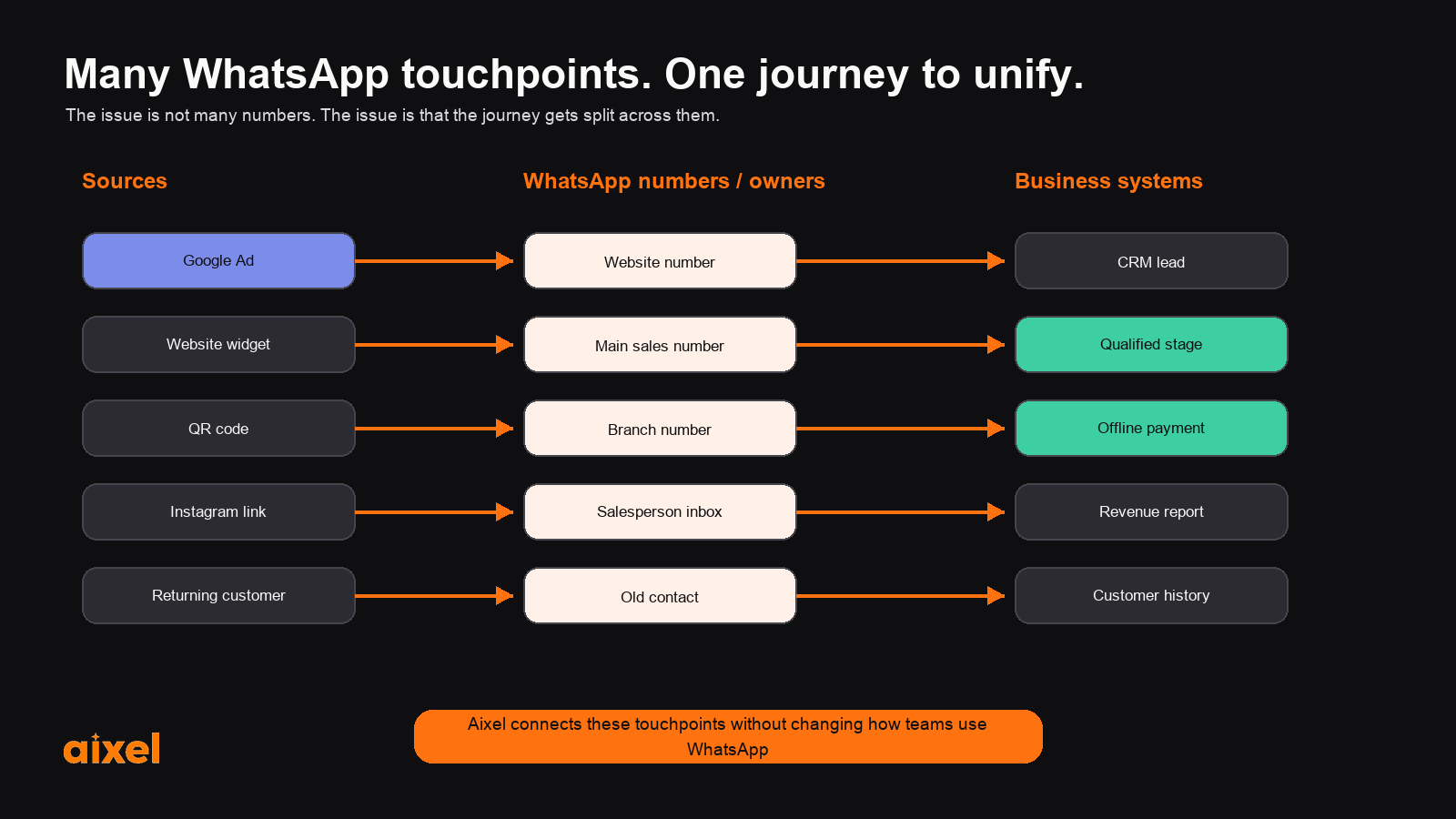
One number sits on the website. Another is used by a branch. Another is used in ads. Salespeople have their own WhatsApp inboxes. QR codes point to different numbers. Old customers message old contacts. The business is getting demand, but the journey is spread across too many places.
The real question is not only: “Can we track WhatsApp?”
The better question is: “Can we understand the customer journey happening inside WhatsApp, and learn which conversations become revenue?”
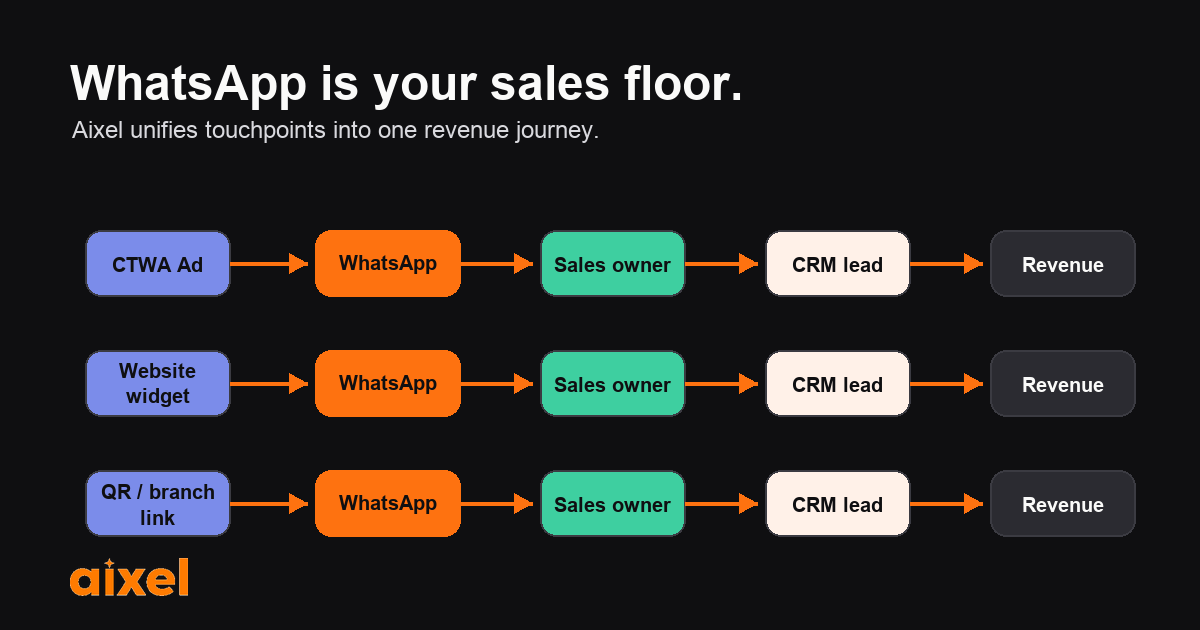
That is the problem Aixel solves. Aixel helps unify those WhatsApp touchpoints into one journey: source, conversation, salesperson, CRM stage and offline revenue.
A simple story
Imagine a customer visits your website from a Google ad. They land on a service page, read the offer, check pricing, and click the WhatsApp widget because they want to speak to someone before buying.
The conversation moves to WhatsApp. The customer asks a few questions. A salesperson replies. Maybe the person wants a quote, a callback, a site visit, a demo, a payment link or a custom package.
The sale does not happen on the website. It happens later.
The salesperson updates the CRM. The lead becomes qualified. A quote is sent. The customer pays offline, or the deal is marked as won.
Now ask a simple question: Can the business connect that CRM conversion back to the original website visit?
In most setups, the answer is no. Google Ads may show a click. Website analytics may show a session and a WhatsApp button click. WhatsApp may show the conversation. The CRM may show the converted lead. But the connection between those systems is weak or missing.
Website visit → WhatsApp conversation → CRM conversion → offline revenue
To the customer, this was one buying journey. To the business, it becomes separate records.
That is the exact gap Aixel helps close: linking the website visitor, WhatsApp conversation, CRM lead and revenue outcome into one journey.
Conversations can start anywhere
In a WhatsApp-first business, leads do not enter through one neat form. They can start from:
- Click-to-WhatsApp ads.
- Website widgets.
- Product-page WhatsApp buttons.
- Instagram bio links.
- Google Business Profile.
- QR codes in stores, clinics, events, brochures, invoices or packaging.
- Salesperson numbers.
- Branch numbers.
- Partner and influencer links.
- Old customer threads.
- Direct messages from saved contacts.
This is why source visibility becomes difficult. This is one instance of a broader pattern — see Why Marketing Attribution Breaks Across Meta, Google, TikTok, CRM and WhatsApp.
If every QR code uses the same WhatsApp number, the business may know that someone messaged, but not which store, event, poster or salesperson created that message.
If multiple salespeople use different numbers, a customer may exist in one person's phone, another person's WhatsApp inbox and the CRM as three different records.
If a returning customer messages an old number, the business may not know that the person originally came from a paid campaign.
The business does not necessarily want to stop using these numbers. In many cases, those numbers exist for good reasons: different branches, different sales teams, different campaigns, different customer relationships.
The issue is not just "tracking." The issue is unification.
The customer journey is fragmented across people, numbers and systems, and the business needs a way to connect those touchpoints without disrupting how the sales team already works.
Labels help small teams, but they do not scale
WhatsApp Business labels are useful. A sales team can label chats as:
- New lead
- Qualified
- Follow up
- Site visit booked
- Pending payment
- Paid
- Not interested
This helps a small team manage work inside WhatsApp. For a small owner-led business, that may be enough. If one or two people handle all chats, labels can work like a simple to-do list.
But labels are not built for scaled measurement.
They are manual. They depend on the salesperson using them correctly. They can be inconsistent across people. They often stay inside WhatsApp and do not create a reliable business view across multiple numbers, salespeople, sources, CRM stages and revenue.
A label can say “Paid.” But it may not answer:
- Which campaign created this customer?
- Was this the first conversation or a returning lead?
- Did the customer speak to another salesperson earlier?
- Which WhatsApp number did they use first?
- Which branch or location handled the lead?
- Did this revenue get connected back to Meta or Google?
- How many similar conversations are stuck at “follow up” and never closing?
So labels are not bad. They are just partial. Use labels for small-team workflow. Use journey measurement when the business needs to understand what is happening across marketing, WhatsApp, sales and revenue.
The hidden problem: business learning is trapped in chats
WhatsApp contains some of the most valuable business data a company has. Customers ask what they care about:
- “Is this available in my city?”
- “What is the final price?”
- “Do you have EMI?”
- “Can I visit today?”
- “Is this suitable for my business?”
- “Why is this more expensive than the other option?”
- “Can you send proof?”
- “Can I pay after delivery?”
These conversations reveal demand, objections, urgency, pricing sensitivity, branch performance, product confusion and sales quality.
But when conversations are spread across multiple numbers and multiple salespeople, the business cannot easily learn from them. One salesperson may know that customers keep asking about payment plans. Another may know that leads from a certain ad are low quality. A branch may know that QR code leads are high intent. The founder may only see total sales.
The learning stays scattered across individual inboxes. This is where a business starts losing leverage. It cannot improve ads properly. It cannot improve landing pages properly. It cannot coach salespeople properly. It cannot know which offline sources are working. It cannot send the right conversion signals back to platforms.
The business is having hundreds or thousands of customer conversations, but it is not learning from them as a system.
What a sensible WhatsApp measurement system should show
A good system should make the journey understandable without making the team do extra manual work. It should answer:
- Where did the conversation start?
- Which WhatsApp number received it?
- Was this a new lead or returning customer?
- Which salesperson or branch handled it?
- Was it labeled or qualified?
- Did it move to quote, visit, demo, booking, payment or lost?
- Did it convert offline?
- Which campaign, QR code, page, location or salesperson created revenue?
- Which conversations should be sent back to ad platforms as qualified leads or purchases?
The goal is not to spy on every message. The goal is to connect commercial signals that already matter to the business:
Where Conversions API fits
This is where Meta Conversions API becomes important. If a business runs click-to-WhatsApp ads, Meta can optimize for people who are likely to start conversations. But a conversation start is not always a good lead.
Some chats are unqualified. Some are support queries. Some are price shoppers. Some never respond. Some become high-value customers. The ad platform needs better feedback.
If Aixel can identify which WhatsApp conversations became qualified leads, appointments, bookings, purchases or offline revenue, those outcomes can be sent back through server-side or offline conversion flows where appropriate.
That changes the optimization loop. Instead of teaching the platform: “Find more people who click WhatsApp.” the business can move toward: “Find more people like the ones who became qualified leads or customers.”
The same principle applies beyond Meta. Google Ads offline conversion imports and enhanced conversions for leads can help connect lead and revenue outcomes back to ad interactions when the setup supports it.
For the mechanics of Conversions API itself, see Conversion API vs Pixel vs Server-Side Tracking, for a dedicated technical deep-dive on fixing Click-to-WhatsApp ad attribution (ctwa_clid), read The WhatsApp Conversions API: A Marketer's Guide, and for a real-world multi-team organizational deployment, explore our EdTech Master Number and Team Attribution Case Study.
The point is simple: Do not let ad platforms learn only from chat starts if your business cares about revenue.
How Aixel unifies the journey
Aixel's role is not to add another isolated report. It is to connect the parts of the journey that are currently split across tools.
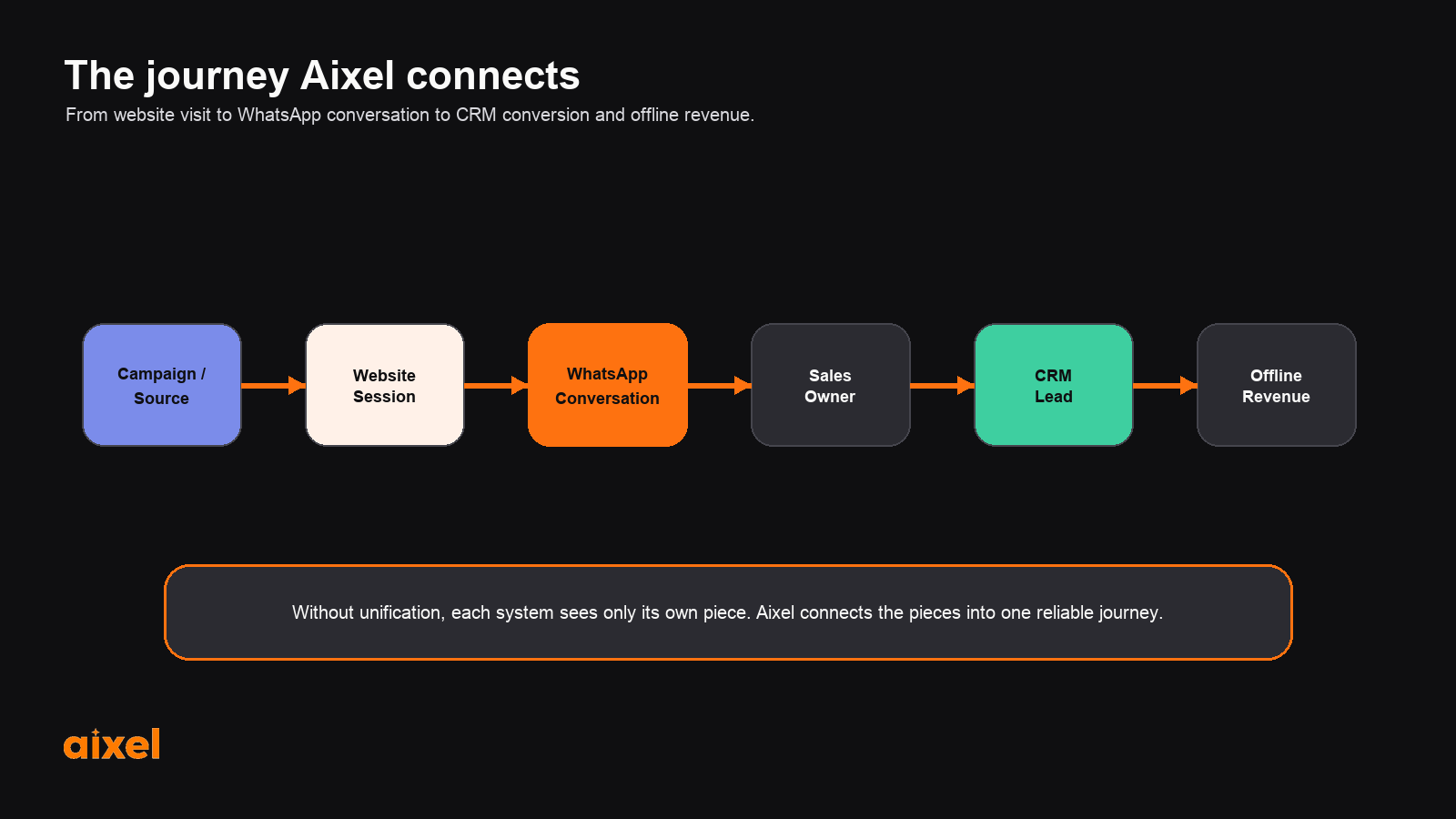
When someone visits the website and clicks the WhatsApp widget, Aixel can preserve the source and session context. When the same person starts a WhatsApp conversation, Aixel can connect that chat back to the website journey. When the lead is created or updated in the CRM, Aixel can connect the CRM outcome back to the original conversation. When revenue is recorded, Aixel can connect the sale back to the path that created it.
The point is simple:
- Website analytics knows the visit.
- WhatsApp knows the conversation.
- CRM knows the lead stage.
- Payment or sales systems know the revenue.
Aixel helps unify them. That creates one connected view:
Campaign/source → website session → WhatsApp conversation → CRM lead → offline conversion → revenue
This also applies beyond the website widget. If conversations start from click-to-WhatsApp ads, QR codes, short links, branch numbers or sales numbers, the same principle applies: connect the source, the conversation, the owner, the CRM outcome and the revenue.
The value is not just more analytics. It is one reliable journey — see The Unified Measurement Layer for the complete model.
The practical model
For a WhatsApp-first business, the model should be simple:
- 1. Capture the entry point
Know whether the conversation came from a CTWA ad, website widget, QR code, short link, branch number, salesperson link, organic social or returning customer. - 2. Unify numbers and people
Connect multiple WhatsApp numbers, salespeople, branches and CRM records so the business can see one customer journey while sales teams continue working in the tools they already use. - 3. Use labels, but standardize them
Labels are helpful only if the team uses them consistently. Keep them simple and aligned with the sales process. - 4. Preserve history
Do not overwrite the first source when the customer returns through another channel. Keep first touch, latest touch, WhatsApp entry point and owner history. - 5. Connect outcomes
Link conversations to qualified leads, visits, quotes, bookings, purchases, offline payments and revenue. - 6. Feed learning back
Use the outcome data to improve ads, landing pages, sales follow-up, branch operations and platform signals through Conversions API or offline conversion workflows where appropriate.
Common mistakes
- Treating every WhatsApp message as a lead.
- Treating every lead as equal.
- Measuring only chat starts from CTWA ads.
- Using the same WhatsApp number or QR code everywhere without source separation.
- Depending on manual labels as the full measurement system.
- Depending only on individual inboxes as the business's source of truth.
- Overwriting the original source when the customer returns.
- Not connecting WhatsApp outcomes to CRM and revenue.
- Not sending qualified outcomes back to ad platforms.
The Aixel point of view
WhatsApp is where the customer tells you what they want. But if those conversations are scattered across ads, QR codes, website widgets, multiple WhatsApp numbers, labels, salespeople and offline sales, the business cannot see the full journey.
It can see activity, but not the journey.
Aixel's role is to unify the touchpoints while coexisting with how the team already uses WhatsApp. The sales team can keep using WhatsApp. Branches can keep their numbers. Campaigns can keep using links and QR codes. Aixel sits across the journey and connects what would otherwise remain separate.
The question is not just: “How many WhatsApp messages did we get?” It is: “Which conversations mattered, where did they come from, who handled them, what did we learn, and which ones became revenue?”
Eventia Events is a real example of this exact WhatsApp-to-CRM journey working in practice.
That is the measurement layer WhatsApp-first businesses need.
Frequently asked questions
- Are WhatsApp Business labels enough?
- No. Labels are useful for organizing chats and sales follow-up, but they are manual and partial. They do not by themselves show the full journey across source, number, salesperson, CRM stage and revenue.
- Should businesses still use labels?
- Yes. Use labels for simple workflow: new lead, qualified, follow-up, paid, lost. But connect them to a broader journey measurement system.
- What if a business uses multiple WhatsApp numbers?
- That is exactly where measurement becomes important. Multiple numbers often mean fragmented customer records, uneven sales follow-up and unclear source attribution. A business needs one view across numbers, people and outcomes.
- How should click-to-WhatsApp ads be measured?
- Measure beyond conversation starts. Track which conversations became qualified leads, appointments, bookings, purchases or offline revenue, then use those outcomes to improve reporting and platform optimization.
- Where does Conversions API fit?
- Conversions API can help send stronger conversion signals back to Meta, such as qualified leads or purchases, instead of relying only on browser events or chat starts.
- Does this require reading every WhatsApp message?
- No. The core measurement can be built from source data, conversation metadata, labels/status, owner history, CRM stages and revenue outcomes. Message content can be useful for business learning only when handled carefully with the right consent and privacy practices.
Ready to recover your attribution signal?
Connect Meta, Google, TikTok, and WhatsApp in one platform. No code required.
Get started free
