

The Short Answer
Marketing attribution breaks for seven recurring reasons:
- Every platform uses its own attribution window and credit rules. A platform may count a conversion after a click, view or engaged view that another tool ignores.
- Customer identity fragments across browsers, devices and systems. An ad platform may know a click ID, the website a cookie, the CRM an email address and WhatsApp a phone number.
- Browser and consent controls remove observable signals. Safari blocks third-party cookies, users can restrict tracking, and analytics tools may model behavior that was not directly observed.
- Client-side events fail. Ad blockers, page exits, script errors, consent states and checkout-domain changes can prevent browser pixels from firing.
- Browser and server events are duplicated or mismatched. Sending the same purchase twice without a shared event ID can inflate reporting; inconsistent fields can stop platforms from recognizing duplicates.
- CRM and messaging conversions happen after the web session ends. A lead may convert days later in WhatsApp, over the phone or through a sales representative.
- Revenue systems and marketing systems answer different questions. Shopify or an ERP records booked revenue; an ad platform estimates which ads influenced it; a CRM records pipeline ownership; analytics describes sessions and events.
The result is not one broken dashboard. It is a broken chain of evidence.
The dashboards disagree because they are not measuring the same journey, using the same identity, applying the same attribution rule, or even answering the same business question. Meta, Google, TikTok, your CRM and WhatsApp can each report a defensible number while the combined picture remains misleading.
For growth teams, the practical goal is not to force every dashboard to match. It is to build a measurement system that records conversions once, preserves the evidence needed to connect them to earlier touchpoints, and makes the rules for assigning credit explicit.
This guide explains where attribution breaks, why server-side tracking helps without solving everything, and how a first-party measurement layer can create a more reliable view of revenue.
Attribution is a credit system, not an accounting ledger
Revenue accounting asks, “How much money did the business actually receive?” Attribution asks, “Which interactions should receive credit for influencing that outcome?” Those are different jobs.
Google defines attribution as assigning credit to ads, clicks and other factors along the path to an important action. Its data-driven model estimates the contribution of interactions using path data and conversion probability. TikTok describes an attribution window as the period during which an eligible conversion can be claimed after a click, view or engaged view. Meta likewise offers different click-through and view-through settings.
This produces the first principle of measurement: A conversion total is inseparable from the attribution rule used to produce it.
If Meta reports a purchase under a seven-day click window, TikTok reports it after an engaged video view, and GA4 credits the final non-direct session or distributes credit through a data-driven model, the tools are not Gaslighting you. They are applying different rules to overlapping evidence.
One order can create several valid claims
Imagine this customer journey:
Customer Journey Timeline: Priya's $180 Purchase
Priya watches most of a TikTok video but does not click.
She clicks a Meta retargeting ad on her phone.
She searches the brand on Google using her laptop.
She asks a sizing question on WhatsApp.
A sales agent sends a product link.
She purchases directly from the website for $180.
Eventia Events faced this exact problem with Google Ads and WhatsApp — see how they fixed it.
Depending on configuration and available signals:
- TikTok may claim influence through view-through or engaged-view attribution.
- Meta may claim the purchase because it occurred inside the selected click-through window.
- Google Ads may claim it if the search ad was clicked and the conversion meets its attribution rules.
- GA4 may credit the final observable session or distribute credit using its reporting attribution model.
- The CRM may credit the sales agent or WhatsApp conversation.
- The commerce platform records one $180 order, often with a narrower session-level source.
The business made $180, not $540 or $720. The larger sum appears only when channel-level attributed revenue is added as though each claim were exclusive.
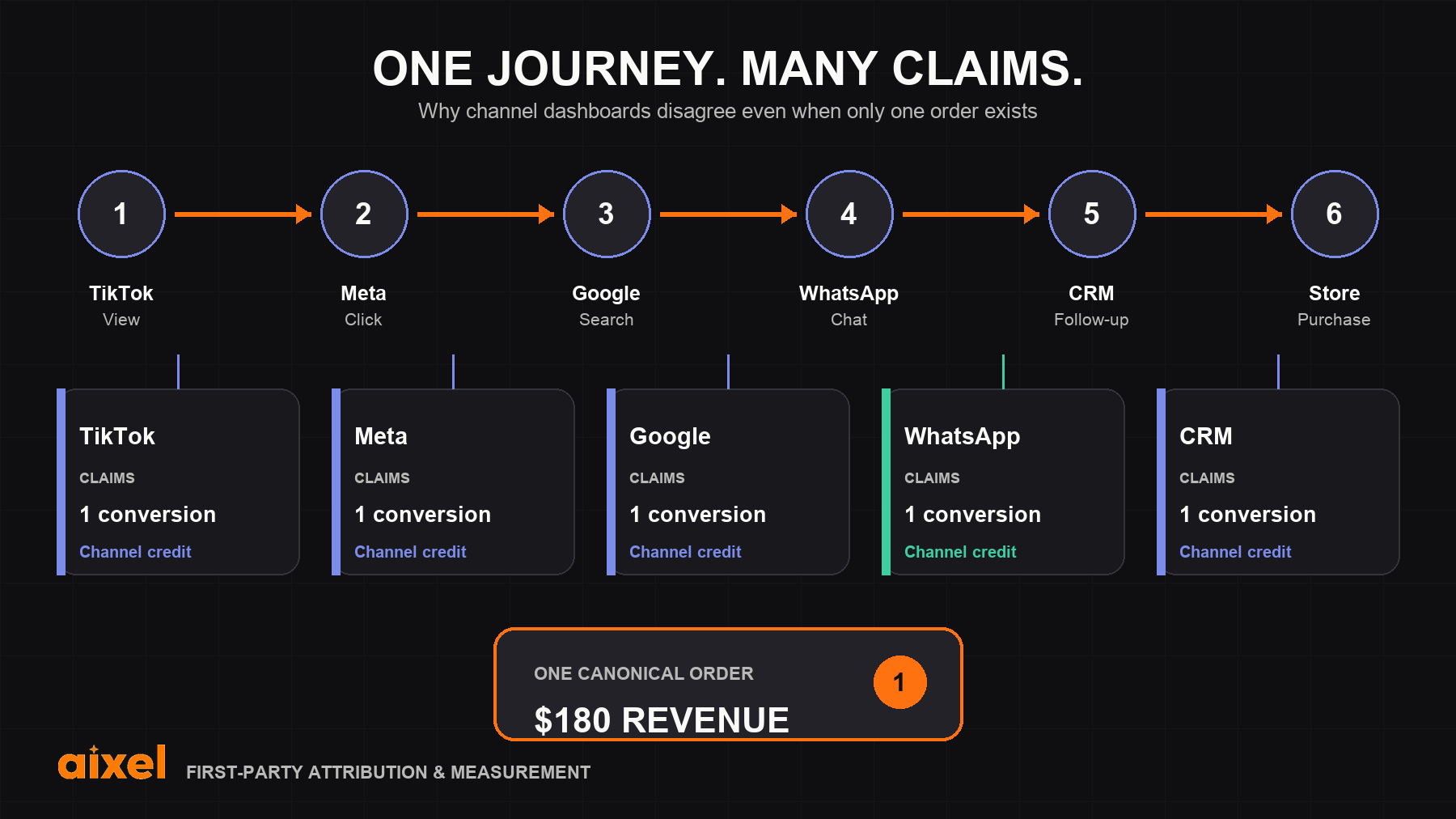
One ecommerce journey can generate several overlapping attribution claims while producing only one real order.
Aixel's unified data attribution is designed to bring these otherwise separate touchpoints into one measurement layer. Instead of treating each platform claim as a separate sale, Aixel connects ad, website, CRM and messaging data to the underlying conversion record so growth teams can compare channel influence against actual revenue.
Where the chain breaks
1. Attribution windows do not align
Attribution windows determine how long an interaction remains eligible for credit. Meta supports multiple reporting settings, including click-through and view-through windows. TikTok allows configurable click, view and engaged-view windows, and explicitly notes that its Ads Manager attribution setting can differ from mobile measurement partner reporting.
This means a conversion can be:
- Inside Meta's window but outside another tool's window;
- Counted after a view by an ad platform but ignored by click-based analytics;
- Reported against the date of ad interaction in one system and the date of purchase in another;
- Reassigned when a reporting window or attribution model changes.
Aixel does not change Meta, Google or TikTok's native attribution windows. It gives the business a separate, cross-channel attribution view built from unified first-party data. Platform reports remain useful for optimization, while Aixel provides a consistent layer for comparing performance across channels.
2. Each system recognizes the customer differently
The same person may appear as several identities:
- A Meta browser or account signal;
- A Google click ID and signed-in account signal;
- A TikTok click or event signal;
- A GA4 client ID or User-ID;
- A Shopify customer and order ID;
- A CRM contact identified by email;
- A WhatsApp contact identified by phone number.
GA4's reporting identity documentation illustrates the problem. Depending on configuration, Analytics may combine User-ID, device ID and modeled data, use only observed identifiers, or rely only on device ID. If the customer changes device, clears storage, refuses analytics consent or converts in a different channel, a deterministic link may not exist.
A first-party data strategy improves this by retaining consented identifiers such as customer ID, email, phone, order ID and platform click IDs. But identity resolution must be governed carefully: collecting more identifiers does not remove consent, data minimization or platform-policy obligations.
Aixel connects marketing and revenue data from advertising platforms, websites, CRM systems and messaging channels. This gives attribution logic a broader first-party evidence set than any isolated dashboard, while still depending on the identifiers and consented data the business actually collects.
3. Browser privacy changes what can be observed
Safari's WebKit states that Intelligent Tracking Prevention blocks third-party cookies by default and applies additional protections to cross-site tracking. That can shorten or sever the observable connection between an earlier marketing interaction and a later visit.
Chrome requires more precise language than many marketing articles use. Google announced in April 2025 that Chrome would maintain its user-choice approach to third-party cookies rather than introduce a new standalone prompt, while continuing stronger tracking protections in Incognito. In October 2025, Google also changed the roadmap for several Privacy Sandbox technologies while continuing work on interoperable, privacy-preserving attribution standards.
So the accurate 2026 statement is not “all cookies are gone.” It is: Cross-site identity and browser-based measurement are increasingly inconsistent across browsers, user settings, consent states and technical environments.
That inconsistency is enough to make a browser-only attribution system fragile.
4. Client-side pixels do not see every conversion
A browser pixel depends on the page, browser and network successfully executing code. Events can be lost when:
- A visitor blocks tracking scripts;
- Consent prevents marketing tags from loading;
- The customer closes the page before the request completes;
- A checkout occurs on another domain or embedded environment;
- A tag is missing, fires twice or receives malformed values;
- Browser storage is unavailable or identifiers expire;
- A single-page application changes state without the expected page event.
Server-side event delivery reduces dependence on that execution path. Meta's Conversions API accepts website, app, offline and business-messaging events. TikTok recommends using Pixel and Events API together for web conversion clients, with consistent events, match keys and deduplication.
However, server-side tracking is not a license to ignore consent or platform policies. It changes the transport and reliability of permitted data; it does not make privacy rules disappear. (In fact, for health and wellness brands on Meta, sending unredacted sensitive URLs or product names through CAPI can trigger severe domain-level data restrictions — see our guide: Meta Health and Wellness Restrictions in 2026.)
Aixel provides server-side tracking and Conversion API connectivity for major advertising platforms. Backend outcomes can be synced without depending only on a browser pixel, helping platforms receive more reliable conversion feedback for measurement and optimization.
5. Server-side tracking can create duplicates
The strongest web measurement setups often send an event through both browser and server paths. The browser can provide useful in-session context; the server can confirm the business event from a more reliable backend source.
But sending both copies creates a new problem: the platform must know they represent the same purchase.
Meta documents deduplication for Pixel and Conversions API events and emphasizes using a consistent event identifier. TikTok requires the same event_id across Pixel and Events API copies of an overlapping event; it keeps or enriches the first recognized event so the same conversion is not counted twice.
A robust purchase event should therefore carry stable fields such as:
- Event name;
- Event ID or transaction ID;
- Event timestamp;
- Order value and currency;
- Source URL or event source;
- Consented matching fields where permitted;
- Platform click identifiers when available.
purchase_completed with another. To a person these look equivalent; to a platform they may be two unrelated events.For the full breakdown of when to use each, see Conversion API vs Pixel vs Server-Side Tracking.
Aixel acts as an event-unification layer, standardizing conversion data before it is synced to ad destinations. A single governed conversion record can support attribution, reporting and downstream event delivery instead of each channel implementing a separate version of the purchase.
6. CRM outcomes happen after the marketing session
Many valuable conversions are not immediate ecommerce purchases. They are qualified leads, consultations, approved applications, subscriptions, repeat purchases or deals closed by sales.
Google's offline conversion guidance explains that an ad can begin a journey that ends later by phone or in an office. Enhanced conversions for leads can use hashed first-party data alongside click identifiers to improve matching between imported CRM outcomes and earlier ad interactions.
Without that feedback loop, ad platforms optimize toward the easiest observable event, often a form fill, rather than the outcome the business values, such as a qualified opportunity or paid order.
CRM attribution also introduces its own rules. A CRM may assign source based on the first recorded campaign, the latest campaign, contact creation, opportunity creation or sales ownership. Unless those rules are documented, “marketing-sourced revenue” can silently change when lifecycle fields are overwritten.
Through CRM data connections, Aixel can bring downstream lead and revenue outcomes back into the attribution journey. Teams can evaluate campaigns against qualified leads, closed revenue or other meaningful CRM stages instead of optimizing only toward the initial form submission.
7. WhatsApp and messaging create an attribution blind spot
Messaging journeys are especially difficult because intent moves from an ad or website into a conversation. The final conversion may occur through a payment link, a manually created order, an offline invoice or a later direct visit.
Meta's Conversions API for Business Messaging supports integrations involving WhatsApp, Messenger and Instagram messaging. This makes it technically possible to return eligible messaging outcomes, such as leads or purchases, to the measurement ecosystem. But reliable attribution still depends on preserving the connection between:
- The ad or campaign that initiated the conversation;
- The messaging thread or contact;
- The CRM record;
- The order or revenue event;
- The timestamp and value of the outcome.
If a click-to-WhatsApp campaign creates a conversation but no durable campaign reference reaches the CRM or order record, the journey becomes difficult to reconstruct. The sales team may know WhatsApp closed the customer, while the ad platform, CRM and commerce system each tell a different story.
For the full playbook on unifying WhatsApp touchpoints, see WhatsApp Is Your Sales Floor.
Messaging attribution is a core Aixel use case. The platform is designed to connect conversions from WhatsApp, Instagram and Messenger with the ads, website interactions, CRM records and revenue outcomes around them. For businesses that sell through conversations, this closes a gap that web-only attribution tools routinely leave open.
8. Data definitions drift between teams
Even perfect event delivery cannot repair inconsistent definitions.
One dashboard may define a conversion as Purchase. Another includes InitiateCheckout. A CRM may count a deal when it enters “Closed Won,” while finance counts revenue only after payment clears. Returns, cancellations, taxes, shipping and currency conversion may be handled differently.
Before debating attribution, align the business objects:
- What is the canonical conversion?
- Which system owns its final status?
- Is revenue gross, net, booked or collected?
- How are refunds and cancellations represented?
- Is a lead counted once per person, form submission or opportunity?
- Which timestamp determines the reporting date?
Without a shared data contract, dashboard reconciliation becomes an argument between incompatible nouns.
Why native platform ROAS should not be your financial source of truth
Native ad-platform reporting is indispensable for campaign optimization. Each platform has signals unavailable elsewhere and uses conversion feedback to improve delivery. But native ROAS is not designed to function as a consolidated revenue ledger across competing channels.
Use platform reporting to answer questions such as:
- Which creatives and audiences are performing within this platform?
- Is conversion signal quality improving?
- How does performance change under a consistent platform attribution setting?
Use a first-party measurement layer to answer different questions:
- How many real conversions occurred?
- Which touchpoints can be connected to each conversion?
- How much credit does each channel receive under one explicit model?
- What evidence is observed, matched, modeled or missing?
- How do attributed outcomes reconcile to CRM and commerce revenue?
Aixel positions its platform around this second problem: connecting advertising, website, CRM, WhatsApp and other first-party signals into a unified attribution layer, while supporting server-side event delivery to major advertising platforms.
How Aixel repairs the attribution chain
The attribution failures described above are connected. A missing browser event weakens platform optimization. A lost click ID prevents a CRM outcome from being matched. A WhatsApp conversation that never reaches the order record leaves both marketing and sales without a complete journey.
Aixel addresses that chain as one system rather than as a collection of disconnected reporting fixes.
This is the same connective layer described in The Unified Measurement Layer.
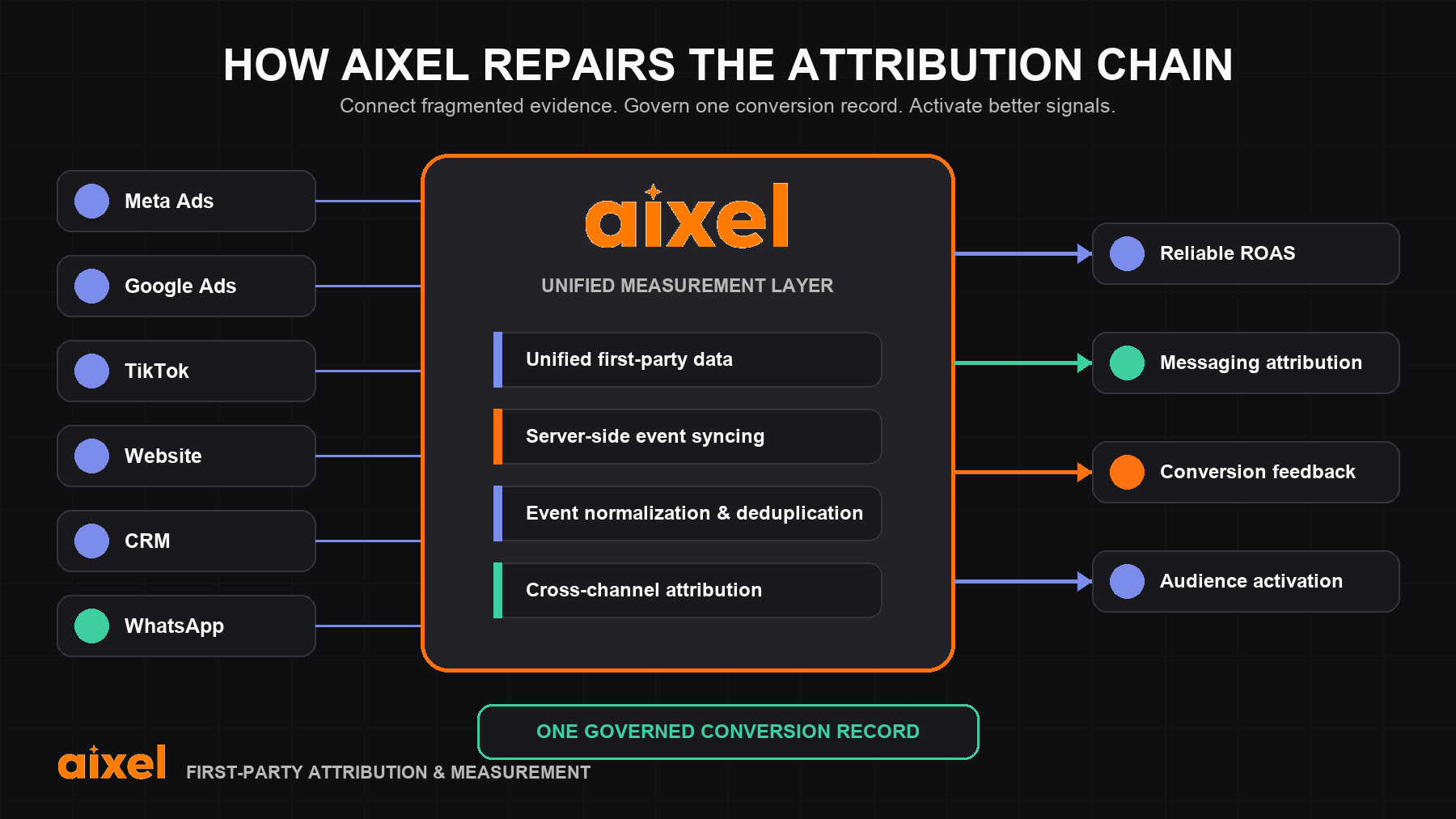
Aixel connects advertising, website, CRM and WhatsApp data to unified attribution, server-side events and activation outputs.
1. Unified data attribution
Aixel brings ad-platform, website, CRM, messaging and offline conversion data into a common measurement layer. This allows the business to evaluate a journey across systems instead of relying on the source label attached by the final dashboard.
The practical benefit is not merely “one more dashboard.” It is a consistent conversion object that can be connected to multiple touchpoints and analyzed under one documented attribution approach.
2. Server-side tracking and Conversion APIs
Aixel sends eligible first-party conversion events to platforms such as Meta, Google and TikTok through server-side integrations. This reduces reliance on browser execution and helps return backend outcomes to the systems optimizing campaign delivery.
Browser and server paths can still be used together. The implementation must preserve event IDs and other matching fields so platforms recognize both copies as one conversion.
3. Messaging attribution
For brands that generate demand and close sales through conversations, Aixel connects messaging activity from WhatsApp, Instagram and Messenger with marketing and revenue data. This makes it possible to evaluate campaigns that create conversations even when the final purchase happens outside a normal website session.
4. CRM and offline conversion connection
Aixel can incorporate CRM and offline outcomes into the customer journey. Growth teams can move beyond optimizing for form submissions and evaluate the campaigns, channels and messages associated with qualified leads and realized revenue.
5. Audience activation
Attribution becomes more valuable when it changes execution. Aixel can use unified first-party data to support audience activation, including retargeting, suppression and high-value customer segments, while sending better conversion feedback into advertising platforms.
6. AI-powered insights
Aixel applies AI-powered analysis to attribution and first-party customer data to help teams identify under-attributed channels, unusual performance patterns and opportunities to improve ROAS or reduce CAC. These insights support decisions; they do not eliminate the need for human judgment, experimentation or financial reconciliation.
Aixel's role is to make the evidence more complete, connected and actionable. It should not be described as making every dashboard identical or recovering data that was never lawfully collected.
What a reliable measurement architecture looks like
A durable setup has four layers.
Layer 1: Canonical business events
Define events from business reality, not only from page behavior. A purchase should originate from the order system. A qualified lead should originate from the CRM stage change. A refund should update the original revenue event. Every canonical event needs a stable identifier. For purchases, the order or transaction ID is usually the natural choice.
Layer 2: First-party identity and journey evidence
Capture the identifiers needed to connect touchpoints, subject to consent and applicable law:
- First-party customer or user ID;
- Email or phone in appropriately protected form;
- Order, lead and opportunity IDs;
- UTM parameters;
- Landing page and referrer;
- Platform click IDs;
- Messaging conversation or campaign references;
- Event timestamps and consent state.
The purpose is not to build the largest possible profile. It is to preserve the minimum reliable evidence needed for measurement and activation.
Layer 3: Event normalization, validation and deduplication
Before events reach dashboards or ad platforms, normalize names, values, currencies and timestamps. Validate required fields. Reuse the same event ID when browser and server copies describe the same action.
This is where a unified platform such as Aixel can reduce fragmentation: one governed event can be prepared for multiple destinations rather than rebuilt independently in every channel.
Layer 4: Multiple views, clearly labeled
No single model answers every question. Maintain at least three views:
- Revenue truth: Canonical orders or CRM outcomes, net of cancellations and refunds.
- Operational attribution: One cross-channel model with documented identity and lookback rules.
- Platform attribution: Native Meta, Google and TikTok reporting used for in-platform optimization.
Do not force these views to become identical. Reconcile and explain their differences.
A practical reconciliation framework
When dashboards disagree, investigate in this order.
Step 1: Establish the conversion control total
Start with the source that owns the business outcome: commerce backend, payment system or CRM. Count unique conversion IDs and calculate revenue using a documented definition.
Step 2: Align report settings
Check date range, account time zone, currency, attribution window, click/view inclusion, conversion-date versus interaction-date reporting and refund treatment.
Step 3: Audit event completeness
Compare unique order IDs against received browser and server events. Segment loss by browser, device, region, consent state and checkout route.
Step 4: Test deduplication
Confirm that browser and server copies use matching event names and IDs. Inspect platform diagnostics for duplicate, delayed or malformed events.
Step 5: Trace identity handoffs
Follow a sample of journeys from click ID or UTM through website, CRM, WhatsApp and order. Find the exact handoff where the campaign reference disappears.
Step 6: Separate observed from modeled results
GA4 can use modeled data when consented identifiers are unavailable and the property is eligible. Other advertising systems also use modeling. Label modeled results rather than mixing them silently with deterministic matches.
Step 7: Quantify the gap
Track metrics such as:
- Percentage of canonical conversions sent server-side;
- Percentage with valid transaction IDs;
- Browser/server deduplication rate;
- Match-key coverage;
- Percentage of CRM outcomes linked to an original campaign;
- Percentage of WhatsApp conversions linked to an order;
- Variance between canonical revenue and attributed revenue by model.
The objective is not a magical 100% match. It is a smaller, measured and explainable gap.
What server-side tracking fixes - and what it does not
Server-side tracking can improve event reliability, recover conversions missed by a browser-only path, connect backend outcomes and send richer first-party context where permitted. It can also make one event available to Meta, Google and TikTok without relying entirely on page execution.
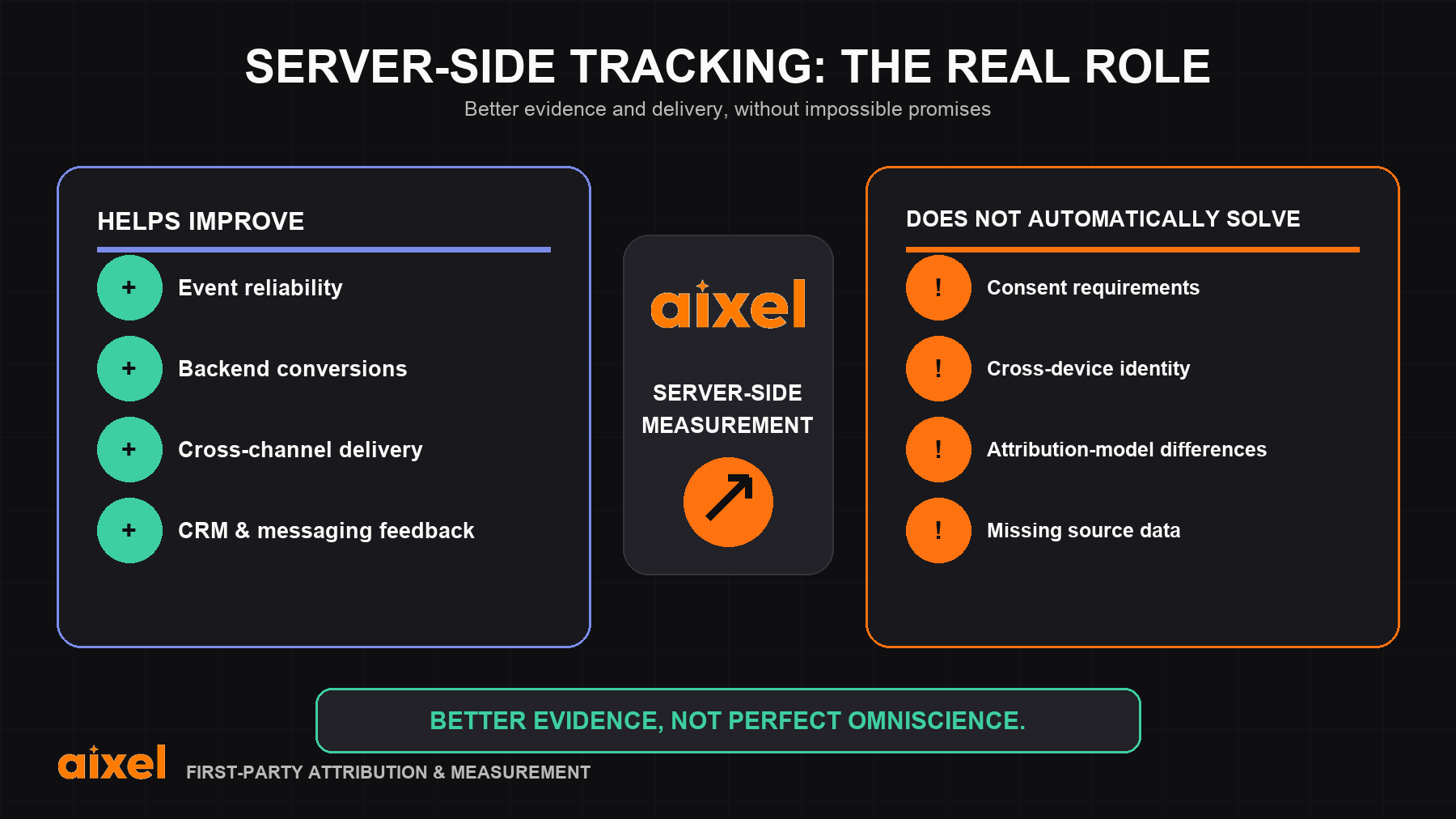
Server-side tracking improves conversion evidence but does not remove consent requirements or attribution-model differences.
It does not automatically:
- Identify every anonymous person across devices;
- Override consent choices or privacy law;
- Remove the need for event deduplication;
- Make competing attribution models agree;
- Prove that an ad caused a conversion;
- Repair missing campaign data that was never captured;
- Turn platform-attributed revenue into audited financial revenue.
The right promise is better evidence, not perfect omniscience.
The operating model growth teams need
Reliable attribution is partly technical and partly organizational. Assign ownership for:
- The event taxonomy and data contract;
- Consent and data-governance requirements;
- Tagging and server-side integrations;
- CRM campaign-field preservation;
- Messaging-to-order linkage;
- Attribution-model documentation;
- Monthly reconciliation and anomaly review.
Marketing, analytics, engineering, sales operations and finance should agree on the canonical conversion before evaluating channel performance. Otherwise, the organization will continue optimizing five dashboards against five definitions of success.
For teams trying to centralize this work, Aixel's first-party attribution platform is built around unifying ad, website, CRM and messaging data, sending conversion events server-side, and creating a more consistent measurement layer across channels.
In practical terms, Aixel is most relevant when a team has several of these problems at once: platform ROAS does not reconcile to revenue, conversions are being closed in WhatsApp or a CRM, browser events are incomplete, and customer data cannot be activated consistently across channels. Explore Aixel's attribution and first-party data platform.
Final Takeaway
Attribution breaks when the evidence connecting a customer interaction to a business outcome is lost, duplicated or interpreted under incompatible rules.
The fix is not another isolated dashboard. It is a first-party measurement foundation that:
- Records each business conversion once;
- Preserves consented journey evidence across ads, web, CRM and messaging;
- Validates and deduplicates browser and server events;
- Sends reliable feedback to advertising platforms;
- Separates revenue truth from attribution views;
- Documents where data is observed, matched, modeled or missing.
That is the shift from arguing about whose ROAS is correct to understanding why each number exists.
Frequently asked questions
Why does Meta report more conversions than GA4?
Meta may count conversions after eligible ad views or clicks inside its configured attribution window, while GA4 applies its own reporting identity, observable session data and attribution model. Consent, cross-device behavior, missing tags and modeled data can widen the difference. Compare equivalent windows and conversion definitions before treating the gap as a tracking error.
Why does TikTok revenue differ from Shopify revenue?
Shopify records orders. TikTok reports orders it attributes to eligible ad interactions under its selected click, view or engaged-view rules. One is a commerce total; the other is a channel-credit view. They should be reconciled, not expected to match exactly.
Can server-side tracking replace pixels?
Not always. TikTok recommends a combined Pixel and Events API setup for web conversions, with deduplication. Meta also supports using browser and server events together. The browser can provide immediate interaction context while the server confirms backend outcomes. The appropriate design depends on consent, platform requirements and the events being measured.
Does the Conversions API bypass Apple ITP or ad blockers?
Server-side delivery is less dependent on browser execution, so it can preserve eligible events that a client-side request misses. But “bypass” is an unsafe description: the implementation must still respect consent, data-protection obligations and platform terms. It also cannot recreate identifiers or campaign evidence that were never collected.
How should WhatsApp conversions be attributed?
Preserve the campaign or ad reference that initiated the conversation, connect the messaging contact to the CRM record, and connect the CRM record to a canonical order or outcome. Return eligible messaging or offline outcomes to platforms where supported, while maintaining one deduplicated conversion record in the first-party measurement layer.
What should be the source of truth for ROAS?
Use canonical net revenue from the commerce, payment or CRM system as the numerator control. Then calculate cross-channel attributed ROAS under one documented model. Keep native platform ROAS as a separate optimization view rather than adding platform-attributed revenue together.
Will all dashboards ever match perfectly?
No. They use different identity spaces, models, windows and data. A mature measurement system aims for consistency of underlying business events and a transparent explanation of credit, not artificial equality between every report.
What attribution problems is Aixel built to solve?
Aixel is built for teams that need to connect paid media, website activity, CRM outcomes, messaging conversations and offline conversions. Its capabilities include unified data attribution, server-side event syncing, messaging attribution, audience activation and AI-powered insights. The platform is intended to complement native ad reporting with a first-party, cross-channel measurement view.
Ready to recover your attribution signal?
Connect Meta, Google, TikTok, and WhatsApp in one platform. No code required.
Get started free
