

A focused measurement rebuild helped an online pharmacy move from restricted AddToCart and Purchase events to compliant conversion signals, reliable first-party attribution and stronger campaign performance.
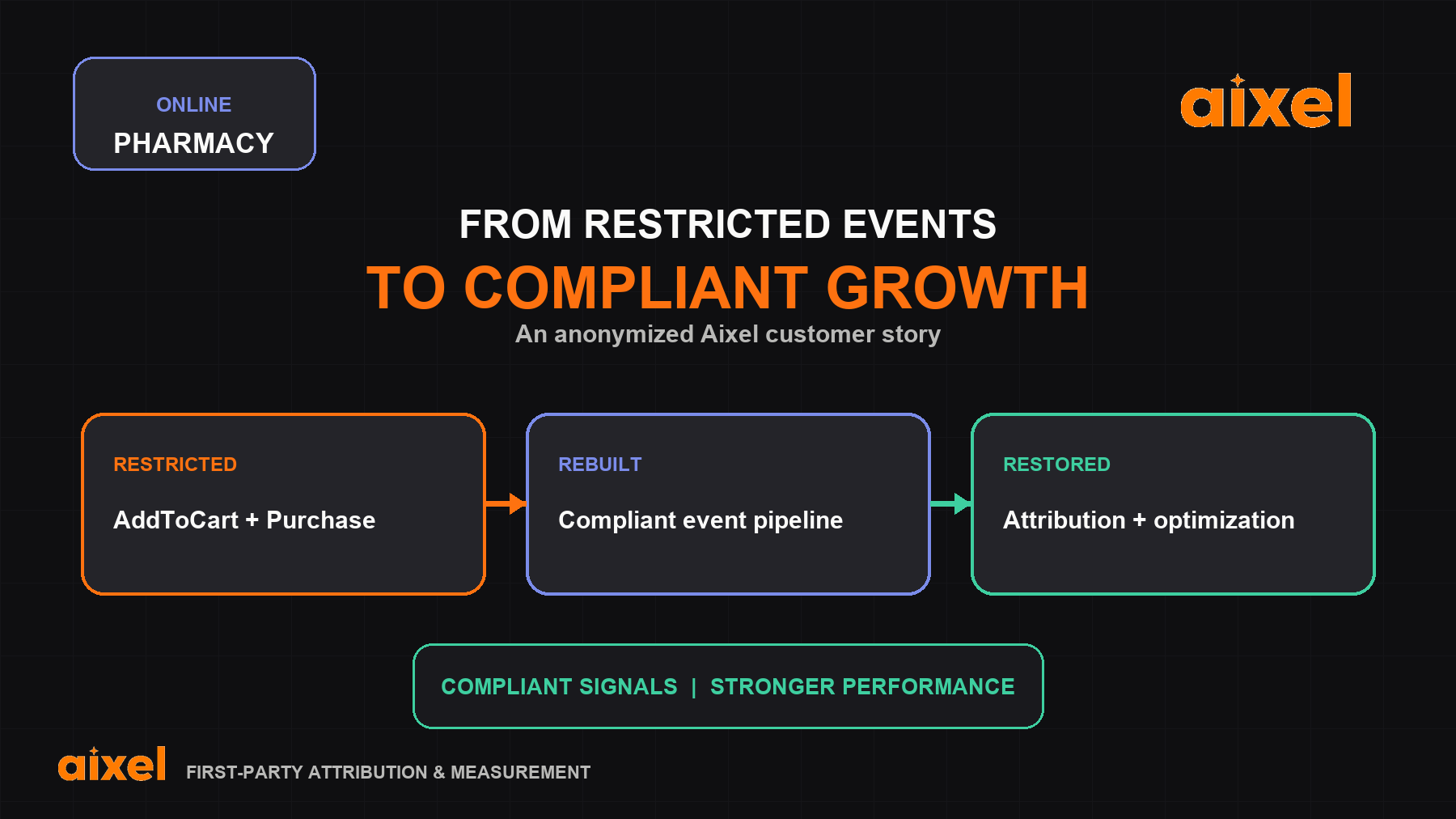
An online pharmacy moved from restricted Meta commerce events to compliant measurement and stronger commercial performance with Aixel.
Executive Summary
The pharmacy retailer's ecommerce growth depended heavily on Meta advertising, but its product catalog also placed the business inside one of Meta's most sensitive policy categories: health and wellness.
Meta began restricting the retailer's AddToCart and Purchase events. The platform could no longer use the same depth of conversion data for reporting and optimization, while browser-side tracking risked exposing product, URL or event information that could reveal health context.
The retailer did not need a workaround. It needed a compliant measurement architecture.
Aixel implemented:
- Compliant event filtering;
- A neutral event taxonomy;
- URL and parameter sanitization;
- Server-side tracking;
- Meta Conversions API delivery;
- Browser-and-server event deduplication;
- First-party attribution across the customer journey.
The result was a cleaner, policy-aligned conversion signal, restored visibility into customer outcomes and stronger commercial performance.
About the customer
The customer is an established online pharmacy and healthcare retailer. Its ecommerce catalog spans medicines, vitamins, skincare, personal care, mother-and-baby products, medical equipment and other health-and-wellness categories.
That breadth creates a powerful ecommerce proposition. It also creates unusual measurement risk: product names, page paths, search terms and event parameters can reveal or imply a customer's health interests.
For a general retailer, a product URL may be ordinary merchandising data. For a pharmacy, the same URL can contain sensitive health context.
The challenge: Meta restricted the retailer's highest-value events
The retailer used Meta campaigns to generate demand and online orders. The most valuable signals in that system were straightforward commerce events:
- AddToCart, showing meaningful purchase intent;
- Purchase, confirming an order and its value.
Those events became restricted under Meta's health-and-wellness controls.
Meta explains that businesses must not send sensitive information, including health information, through its Business Tools. Its health-and-wellness data-source restrictions can also limit the use of certain events for advertising and optimization. (For a deep dive into the three restriction tiers, PII vs. PHI rules, and 2026 content enforcement, see our complete guide: Meta Health and Wellness Restrictions in 2026.)
For the retailer, the restriction created three connected problems:
1. Campaign optimization lost high-value feedback
When Meta cannot use purchase-intent or purchase events normally, campaigns receive weaker feedback about which clicks, audiences and ads are producing real business outcomes. Optimization can drift toward upper-funnel actions that are easier to observe but less valuable.
2. Attribution became incomplete
The business could see orders in its commerce system, but connecting those orders consistently to Meta campaigns became harder. The gap between platform reporting and actual revenue widened.
3. The raw event payload carried policy risk
Simply resending the same browser event through a server would not solve the problem. URLs, product names, custom parameters or event labels could still expose restricted health context. The event had to be redesigned before delivery.
The problem was not merely missing tracking. It was that the existing tracking language and payload were too closely tied to sensitive product context.
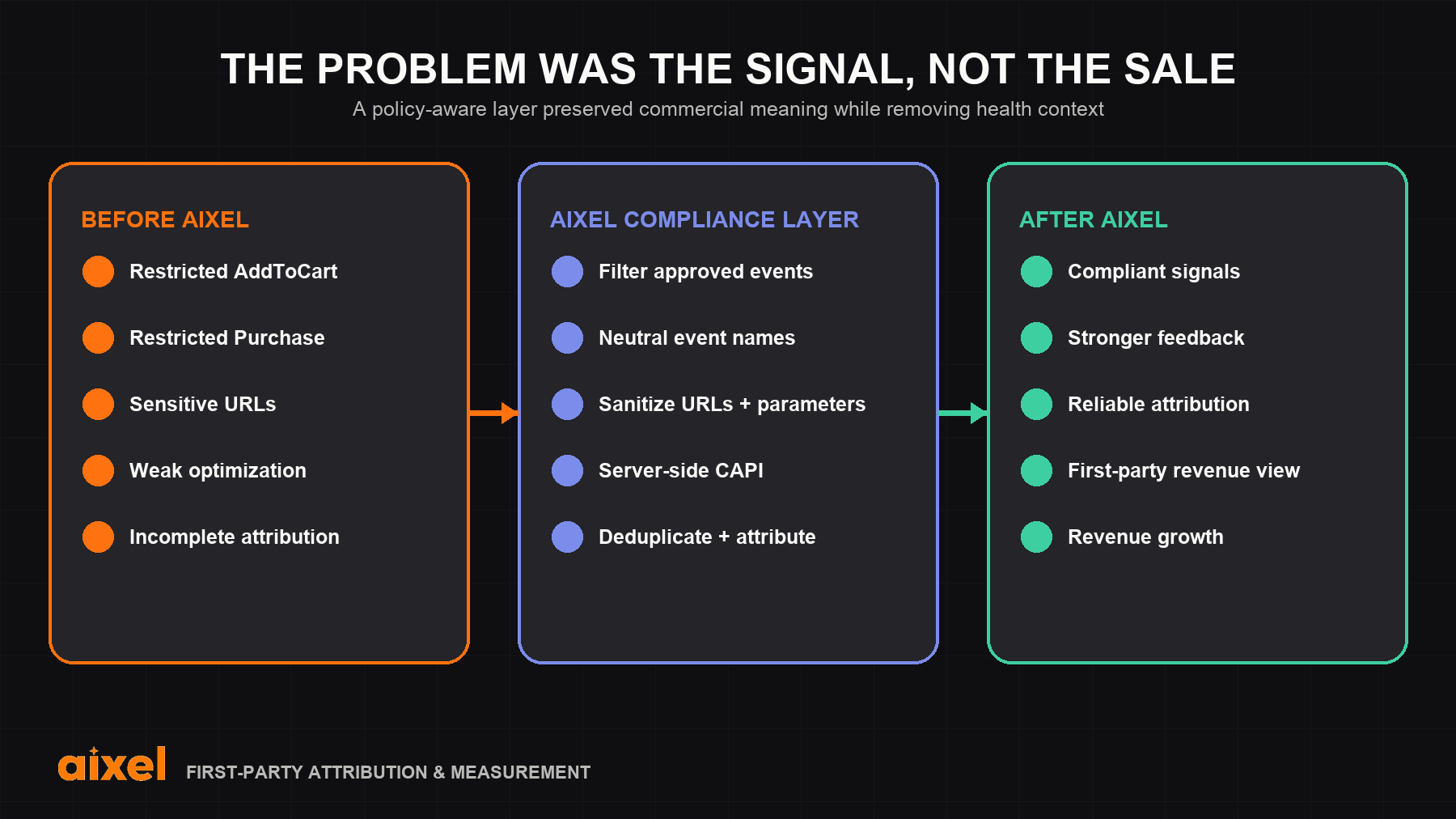
Before Aixel, restricted events weakened optimization and attribution. Aixel introduced a compliant signal layer between the retailer and Meta.
Why pharmacies require a different measurement design
Meta's Business Tools include Pixel, Conversions API, app events and offline conversions. Meta's terms prohibit businesses from sending information that they know or reasonably should know is sensitive, including health information.
In a pharmacy journey, sensitive context can appear in places teams do not initially treat as data:
- Page URLs containing medicine or condition-related terms;
- Product titles and category names;
- Custom parameters describing what was viewed or purchased;
- Search strings;
- Event names built around a particular treatment or health need;
- Audience labels that imply a medical condition.
This is why a standard “send every ecommerce event to Meta” implementation can fail. The correct objective is to preserve the commercial meaning of the conversion while removing health-specific context that Meta should not receive.
The Aixel solution: preserve commerce value, remove sensitive context
Aixel rebuilt the retailer's Meta measurement pipeline around one principle:
Meta needed to know that a valid commerce outcome occurred. It did not need the sensitive health context surrounding that outcome.
Aixel reviewed the event stream and filtered information that should not be sent to Meta. Instead of forwarding every browser payload unchanged, the system allowed only approved commercial signals and fields to proceed. This created a policy-aware boundary between the retailer's first-party environment and Meta's advertising systems.
Events were mapped to neutral, business-level actions rather than health-specific behaviors. The taxonomy described the stage of the commerce journey without revealing the medicine, condition or wellness concern behind it. The distinction is subtle but important: “a valid order occurred” is an operational fact; “a customer bought a product associated with a specific condition” may reveal sensitive context.
Aixel sanitized URLs and event parameters before transmission. Product-specific, category-specific and other potentially sensitive strings were removed or replaced with neutral values. This prevented server-side delivery from simply reproducing the same policy risk that existed in the browser implementation.
Once events were filtered and normalized, Aixel sent eligible conversion signals from the server rather than depending exclusively on browser execution. Server-side tracking improved reliability when browser requests were interrupted, blocked or unavailable. More importantly, it gave the retailer a controlled point where every outgoing event could be validated before reaching Meta.
Aixel used Meta's Conversions API to return compliant conversion feedback. The payload retained the fields required to represent and match a legitimate commerce event while excluding restricted health details. Conversions API did not bypass Meta policy; it provided the transport for a policy-aligned event that Aixel had already filtered, sanitized and normalized.
For a full comparison of Conversions API, pixels and server-side tracking, see Conversion API vs Pixel vs Server-Side Tracking.
Where browser and server events overlapped, Aixel applied consistent event identifiers so Meta could recognize that both signals represented the same action. This prevented restored measurement from producing inflated conversion totals.
Aixel maintained the retailer's own attribution view using first-party journey and revenue data. That gave the team a measurement layer that did not depend solely on what Meta could report inside Ads Manager. The retailer could evaluate campaign influence against its actual orders while keeping sensitive customer context inside the appropriate first-party environment.
The compliant event pipeline
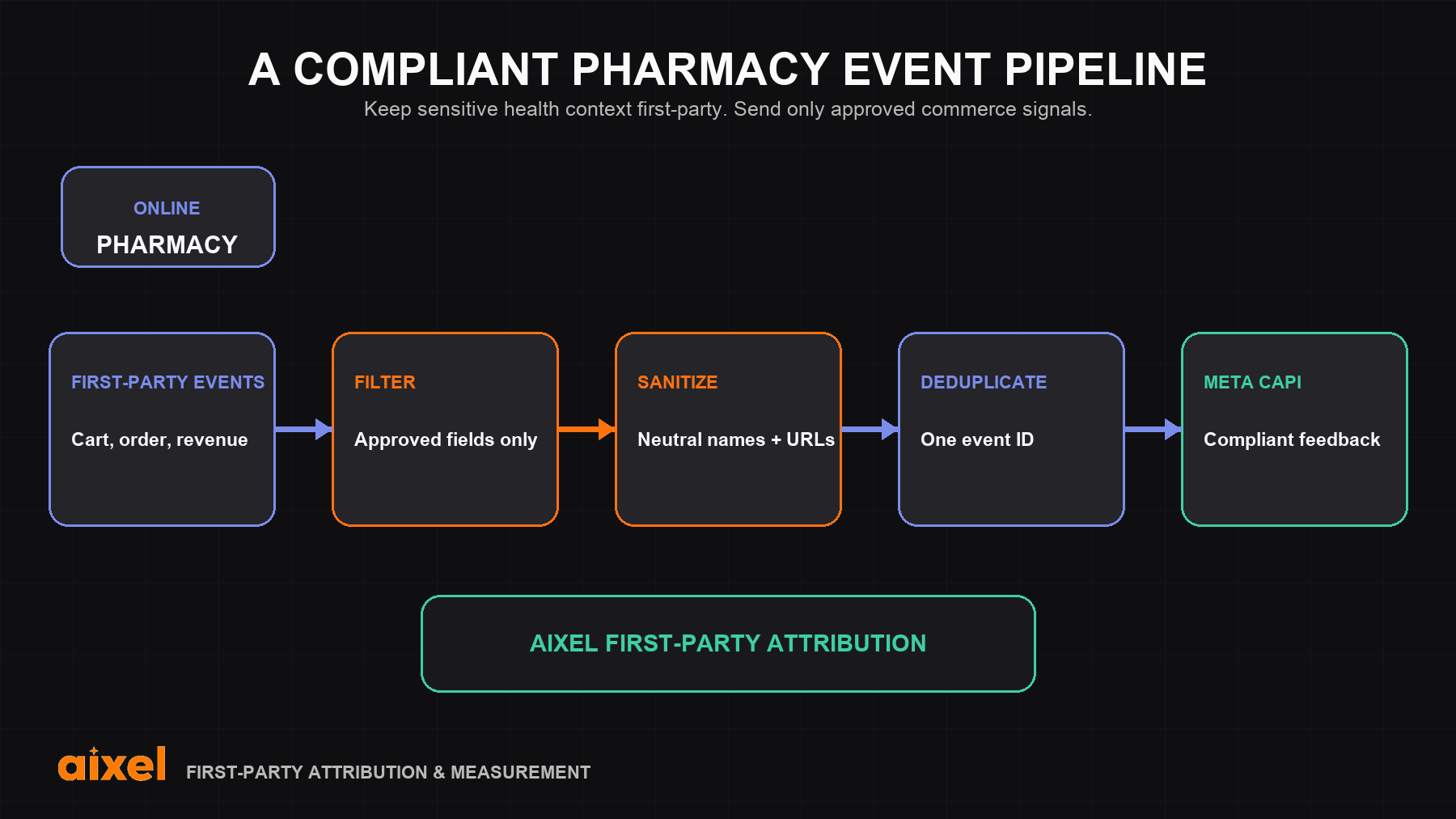
Aixel filters and sanitizes first-party commerce events before compliant server-side delivery and attribution.
The resulting flow separated three responsibilities:
- The retailer remained the source of truth for products, customers, carts, orders and revenue.
- Aixel became the compliance and measurement layer, filtering sensitive context, normalizing events, deduplicating signals and maintaining attribution.
- Meta received approved conversion feedback for campaign reporting and optimization without receiving the restricted product context removed by the pipeline.
Implementation: a focused remediation
The remediation was completed through a focused implementation.
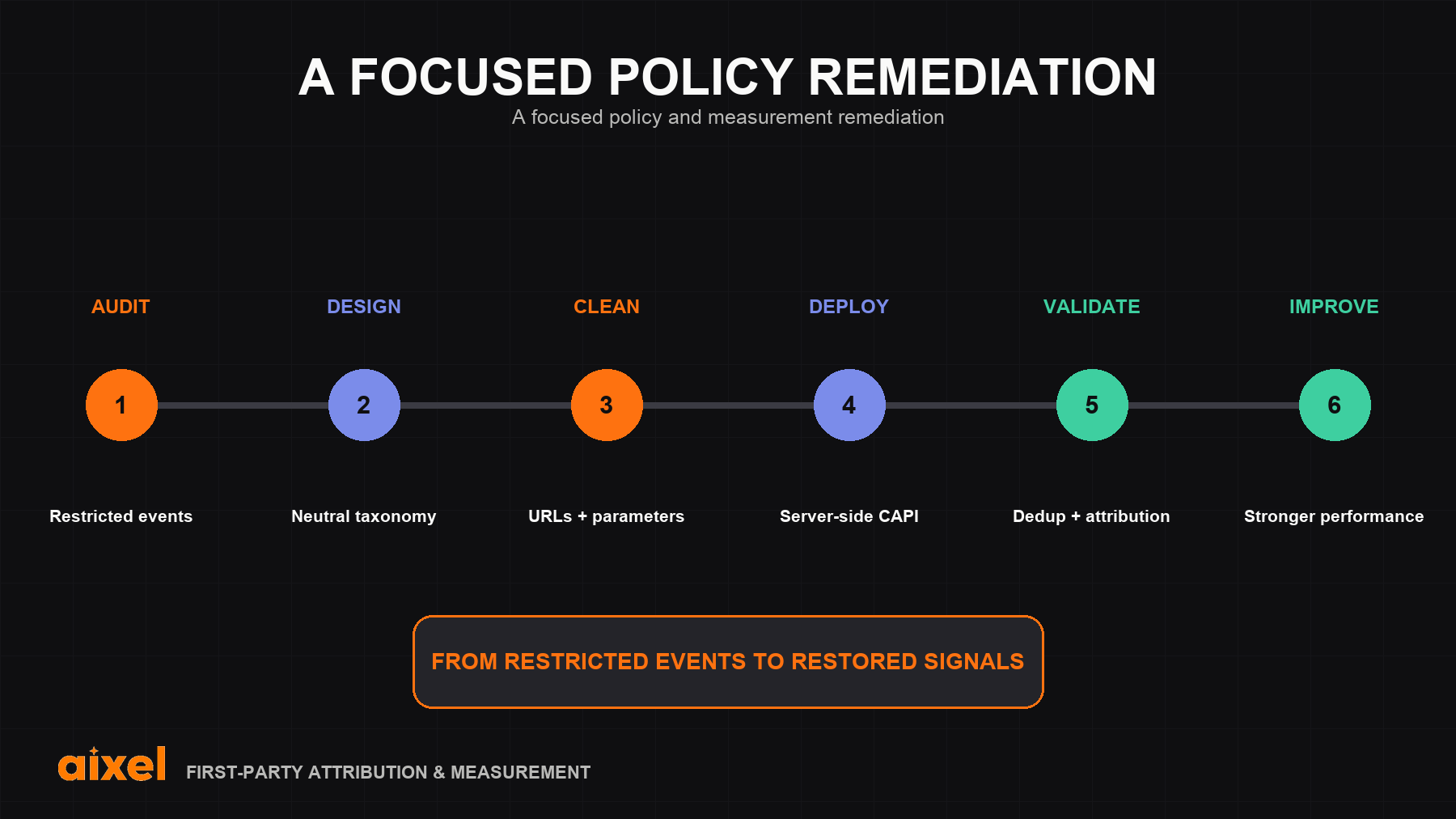
Aixel rapidly completed the retailer's policy-aware measurement rebuild.
The focused implementation covered:
- Auditing restricted AddToCart and Purchase flows;
- Identifying sensitive URLs, event fields and parameters;
- Defining the neutral event taxonomy;
- Configuring compliant filters and sanitization rules;
- Deploying server-side event delivery;
- Connecting Meta Conversions API;
- Validating deduplication;
- Confirming first-party attribution and revenue reconciliation.
Speed mattered because every day with restricted conversion feedback reduced Meta's ability to learn from high-value outcomes. The implementation was narrow, controlled and focused on restoring a trustworthy signal rather than rebuilding the retailer's entire ecommerce stack.
The outcome: attribution recovered and commercial performance improved
After deployment, the retailer regained a usable conversion-feedback loop for Meta and a clearer first-party view of campaign performance. The business saw four practical outcomes:
Meta received cleaner conversion signals
Eligible commerce outcomes could be sent without the restricted health context that had created the original policy problem.
Campaign optimization improved
Meta once again received stronger feedback about downstream commercial outcomes rather than relying only on weaker upper-funnel activity.
Attribution became more dependable
Aixel connected campaign activity to first-party order and revenue data, helping the retailer understand performance beyond the limits of native platform reporting.
Commercial performance improved
With compliant conversion feedback restored and campaigns able to learn from higher-value outcomes, the retailer reported a meaningful improvement in commercial performance. (No percentage or absolute revenue figure is disclosed in this case study).
Why the solution worked
The implementation succeeded because it solved compliance and performance together.
Filtering alone might reduce policy risk but leave campaigns starved of useful signals. Server-side tracking alone might improve delivery while continuing to transmit prohibited context. Attribution alone might explain performance without improving Meta's optimization feedback.
Aixel combined all three layers:
- Compliance: filter, sanitize and neutralize sensitive context;
- Delivery: transmit approved events reliably through server-side integrations and Conversions API;
- Measurement: deduplicate outcomes and reconcile campaign activity against first-party revenue.
That combination allowed the retailer to protect sensitive health context without treating policy compliance as the end of performance marketing.
Lessons for health-and-wellness advertisers
Do not treat Conversions API as a policy bypass
Server-side delivery remains subject to Meta's terms. If a browser event contains restricted health information, copying it into a server payload does not make it compliant.
Audit the payload, not only the event name
A neutral event name can still carry sensitive information inside the URL, product fields, custom data or parameters. Every outgoing field needs review.
Keep sensitive detail inside the first-party environment
The business may need product-level detail for fulfillment, customer service and internal analytics. That does not mean every advertising destination should receive it.
Preserve a first-party attribution layer
Platform reporting can change when policies, consent or technical restrictions change. First-party attribution gives the business a more durable way to connect campaigns with real revenue. See Why Marketing Attribution Breaksfor why platform reporting alone isn't durable.
Optimize for useful compliance
The goal is not to send no data. It is to send the minimum approved information needed to represent legitimate commercial outcomes.
Final Takeaway
The retailer's Meta problem looked like a tracking failure, but the deeper issue was data design. Its most valuable events carried health-and-wellness context that Meta could not accept normally.
Aixel rebuilt that flow rapidly:
- Sensitive context was filtered and sanitized.
- Events were renamed neutrally, delivered server-side through Conversions API, deduplicated and connected to first-party attribution.
The retailer restored useful campaign feedback, recovered clearer attribution and improved commercial performance, without claiming to bypass Meta's health-and-wellness rules.
Ready to recover your attribution signal?
Connect Meta, Google, TikTok, and WhatsApp in one platform. No code required.
Get started free
