
Executive Summary & Key Takeaways
Click-to-WhatsApp (CTWA) ads convert at massive rates, but by default, Meta only knows when a chat opens — not whether it led to a deal. Without reporting downstream outcomes, Ads Manager optimizes for message volume rather than high-value customers.
- The Core Identifier: Every ad tap generates a unique code (
ctwa_clid). Preserving this token across chat opening, salesperson handoffs, and CRM close is the single dependency for attribution. - Three Reporting Paths: Free Business App labels (coarse signal), DIY Conversions API builds (high engineering maintenance), or a managed first-party platform like Aixel (end-to-end preservation).
- Coexistence Support: You no longer need to abandon the familiar mobile app to use the Cloud API. Meta's Coexistence layer allows both to run concurrently on the same number.
Click-to-WhatsApp ads convert well. Meta reports conversion rates roughly 94% higher and cost per lead roughly 92% lower than comparable traditional ad formats. Most teams running them notice this fast.
What's harder to notice: Ads Manager keeps calling the campaign efficient while you can't actually say which conversations turned into revenue. That's not a reporting quirk. By default, Meta only knows a chat opened — not whether it led to a sale. So it optimizes for more chats, not more sales, and the gap between “looks efficient” and “is efficient” quietly widens.
You don't need to understand the API to fix this. You need to know which fix fits your team, what to hand your developer or agency if you're going the technical route, and how to check afterward that it's actually working. That's what this guide is for.
Which fix is right for you
- No developer, no agency, want something today.Turn on WhatsApp Business App labels. Five minutes, zero cost, a coarse signal — see below.
- You have engineering or agency resources and want precise, order-level reporting.You need the Conversions API. You won't build it yourself, but you should know exactly what to ask for — see “What to ask your developer or agency for.”
- You want precision without owning a technical build, and your leads move into a CRM or a salesperson's hands after WhatsApp.That's the case a managed platform like Aixel is built for — see below.
Most teams running any real ad spend on WhatsApp end up needing the second or third option. The free label signal is a real starting point, but it can't tell you which conversation was worth ₹50,000 and which was worth ₹500.
Why Meta can't see this on its own
A Click-to-WhatsApp ad opens a chat directly from Facebook, Instagram, or Reels — no landing page, no website session Meta already knows how to track. That's why it converts so well, and why it's hard to measure: everything that happens after the tap — qualifying, negotiating, the payment link, the order — happens inside a private conversation.
Meta isn't entirely blind. WhatsApp is its own infrastructure, so it does pick up message depth— a rough sense of how far a conversation went, based on how many messages were exchanged. But it doesn't know whether the conversation actually led anywhere, and it doesn't publish how much that raw activity counts toward ad delivery versus an explicit reported outcome. Treat it as a real but unmeasured signal, not a substitute for reporting.
Without something explicitly reporting outcomes back, “more conversations” is the only business-shaped signal Meta's ad system has — so that's what it chases. (To understand how this dynamic causes discrepancies across channels, see our breakdown of why marketing attribution breaks across platforms.)
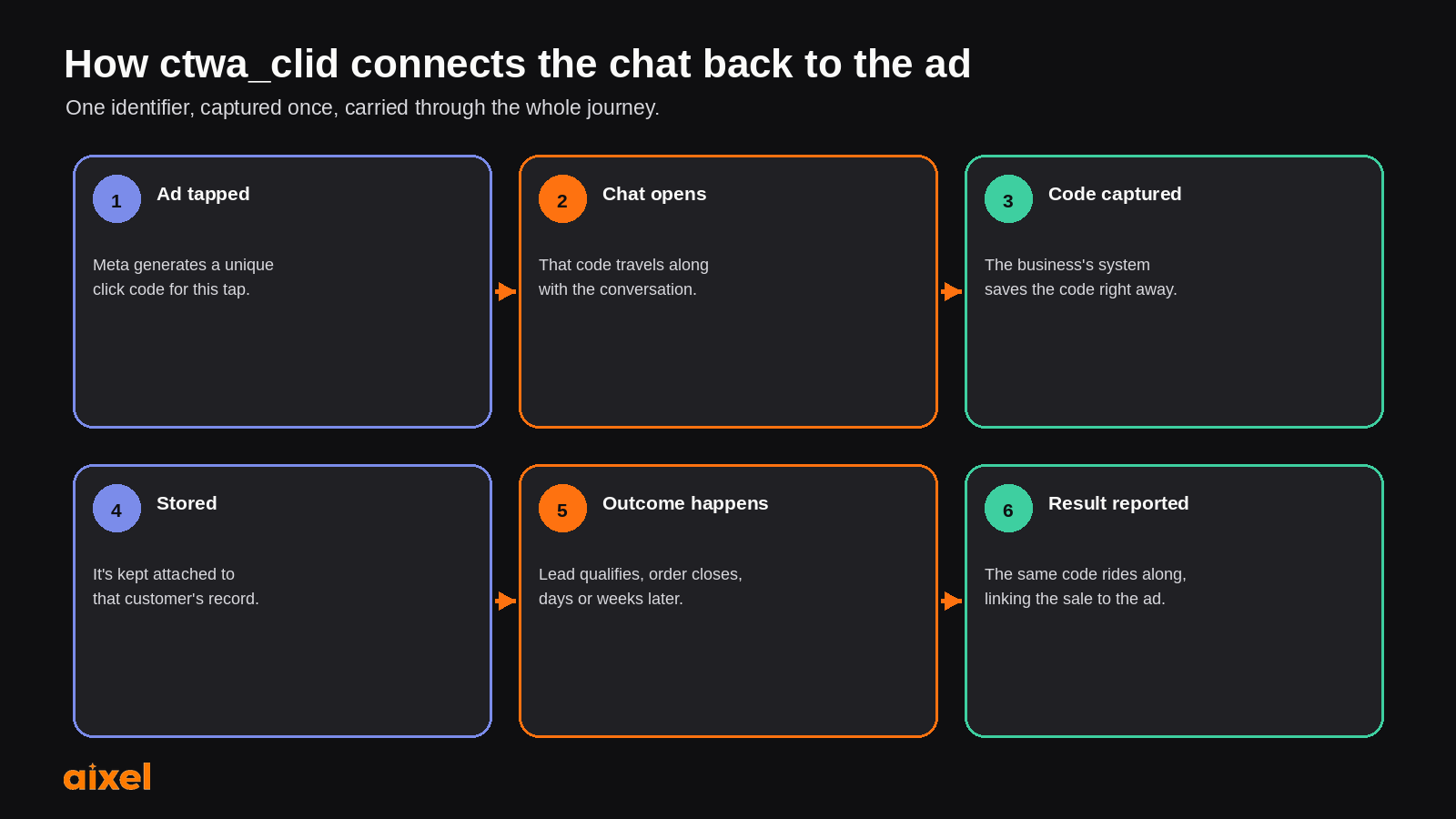
The one thing your dev will mention: ctwa_clid
Every tap on a Click-to-WhatsApp ad generates a unique code — Meta calls it ctwa_clid— that travels into the chat the moment it opens. It's a claim ticket for that specific ad tap. It's the only thing that lets anyone later say “this sale came from this ad,” and if it's lost anywhere along the way, no amount of correct setup elsewhere fixes that: the sale still happens, the money still moves, and Meta never gets the credit.
You don't need to know how it's generated. You do need to know it exists, because it's the thing to ask about in every conversation below — is it being captured, is it being kept, is it still attached when the deal actually closes.
Three ways to report a conversion back to Meta
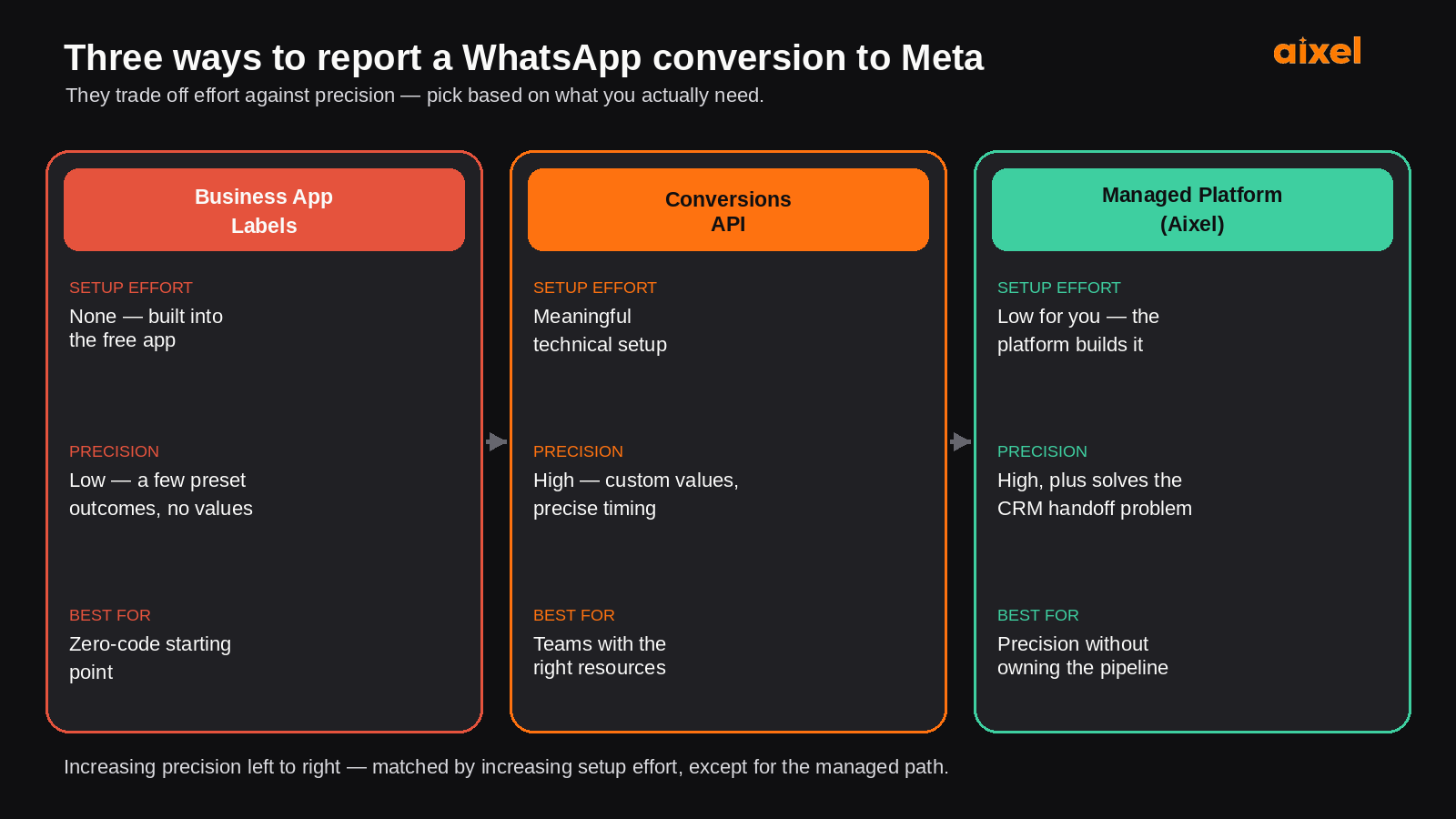
| Method | Setup effort | Precision | Best for |
|---|---|---|---|
| Business App labels | None — built into the app | Low. A few preset outcomes only, no order values | Small businesses not ready for technical integration |
| Conversions API | Meaningful technical setup | High. Custom values, precise timing, full control | Teams with the resources to build and maintain it |
| A managed platform (e.g. Aixel) | Low for you — platform builds and maintains it | High, plus solves handoff-to-CRM problem DIY builds miss | Businesses that want precision without owning the pipeline |
1. Business App labels — do this today, regardless of what else you do
The free WhatsApp Business App has predefined labels — New Customer, New Order, Pending Payment, Order Complete — that whoever manages the number can apply to conversations by hand. Inside the app's settings there's a toggle to share that labeling activity with Meta. Turn it on and Ads Manager starts building a rough profile of what a “converting” conversation looks like.
Two things to check, since this is where most businesses lose the free signal without realizing it:
- The sharing toggle has to be switched on.It isn't automatic — confirm with whoever has the app installed.
- Only the built-in labels count. Custom labels your team created for internal use are ignored for this purpose.
This costs nothing and takes five minutes. It's also genuinely coarse: a handful of fixed outcomes, no order values, no way to tell a ₹500 order from a ₹50,000 one. Turn it on regardless of which other option you pursue — it's not a replacement for the Conversions API, but it's not competing with it either.
2. The Conversions API — what to ask your developer or agency for
This is the option that reports exact, structured outcomes to Meta — what happened, when, and for how much — instead of just “a chat happened.” You almost certainly won't build this yourself. What you need is a short list of questions that tell you whether whoever is building it has actually done it right.
Ask them to confirm, in plain terms:
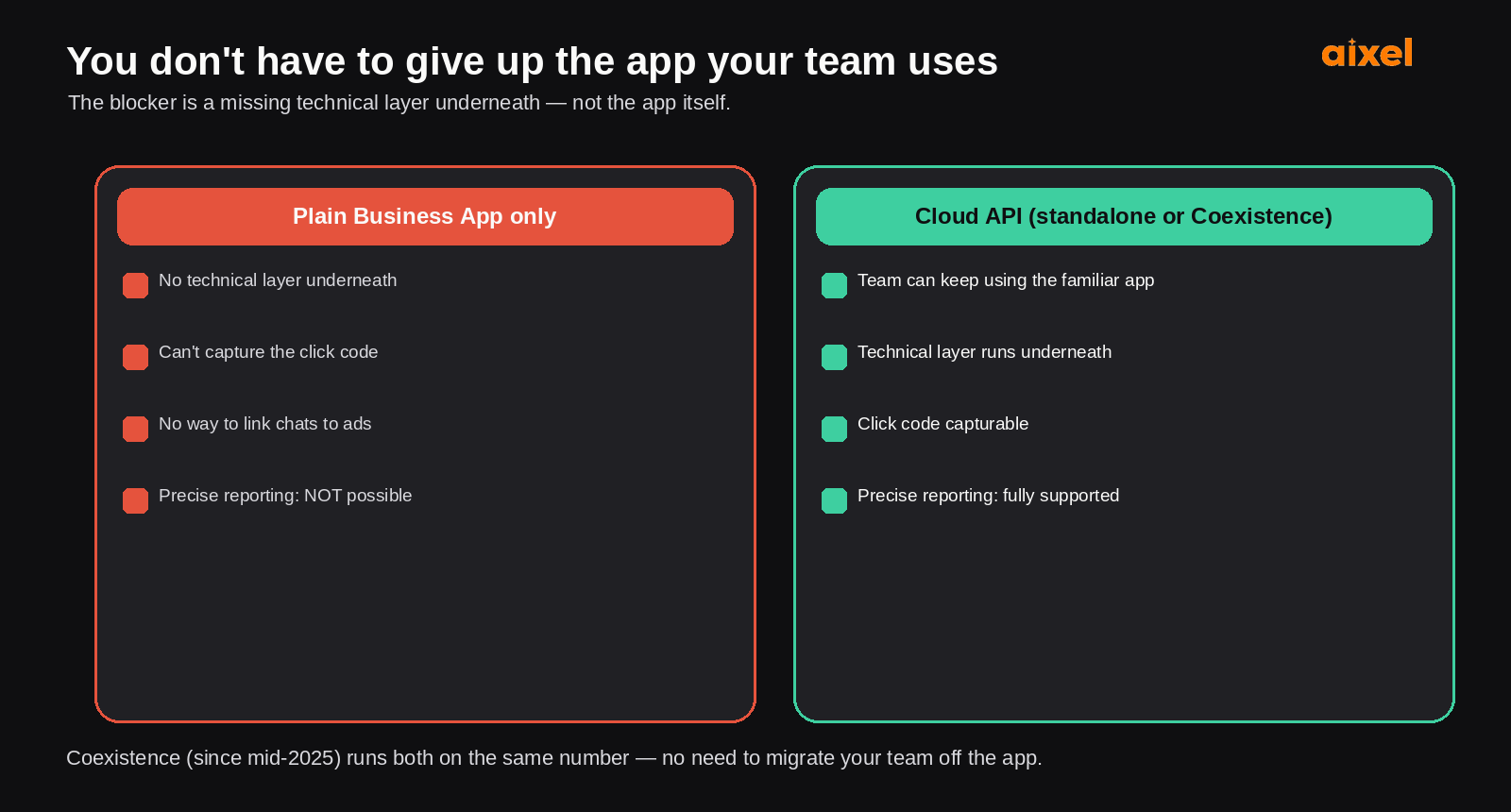
- “Are we running WhatsApp Cloud API on this number, or the plain Business App?” — the plain app cannot capture the click code at all. If the answer is “just the app,” none of this works yet. (Meta's Coexistencefeature, live since mid-2025, lets the team keep using the familiar app on the same number while Cloud API runs underneath — so this doesn't have to mean replacing anyone's workflow.)
- “Are we capturing
ctwa_clidthe moment a chat opens, before anything else happens?” — if it isn't captured at that first moment, it's gone for good; it can't be recovered later from the message content. - “Where is that code stored, and does it stay attached to the customer record — not just the chat?” — this is the step most implementations get wrong. See the CRM section below.
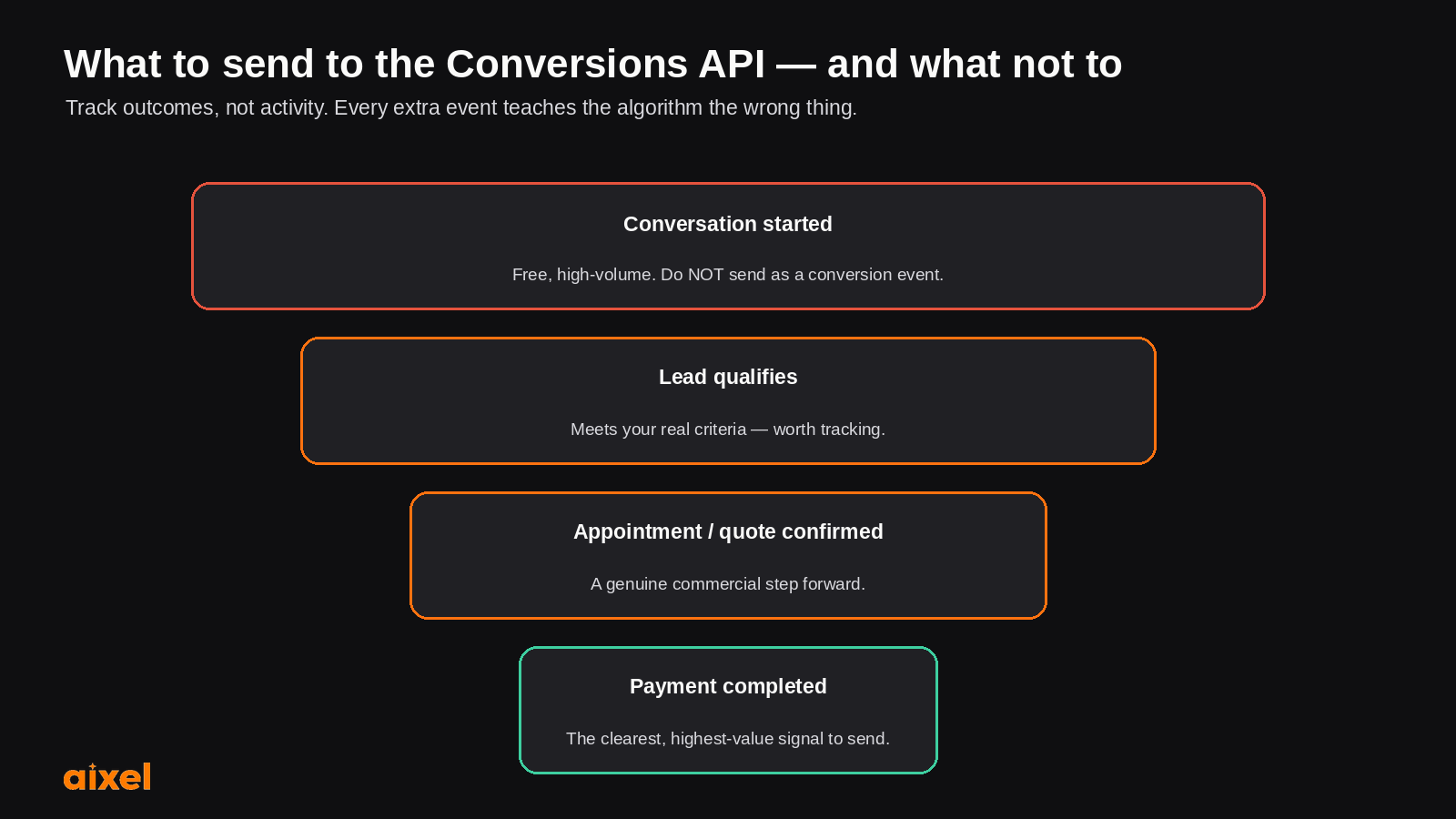
- “Are we only sending Lead and Purchase events, or are we sending something on every message?” — WhatsApp's version of this only supports two outcome types. Anything sent more often than a real outcome teaches Meta to optimize for people who chat, undoing the whole point.
- “If we run more than one WhatsApp number, is each number's data going into its own separate dataset?” — mixing numbers together breaks attribution for all of them, silently.
If any of those answers is vague, that's the gap to close before trusting the numbers in Ads Manager.
3. A managed platform — precise, without owning the build
The checklist above is real work, and the hardest item on it — keeping ctwa_clidattached to a lead after it leaves WhatsApp — is usually the one an internal team or agency underestimates. Platforms like Aixel handle that layer directly: capturing the code the moment a conversation starts, keeping it attached as the lead moves through your actual sales process, and reporting the outcome to Meta only when something real happens, without double-counting if more than one system touches the same lead.
If you'd rather hand the checklist above to a platform than manage it across your own dev team, CRM, and sales process, this is the option built for that.
How to tell if it's actually working
Once something is reporting to Meta — labels, API, or a platform — don't just trust that it's live. Check:
- In Events Manager, are real events showing up with a reasonable match rate, not just a handful of test events from setup week?
- Does the reported conversion count and value roughly match what Finance or your CRM shows for the same period?A persistent gap between Ads Manager and your actual sales numbers is the clearest sign the click code isn't surviving the full journey.
- Ask for one real example — a lead that closed, and confirmation that the same
ctwa_clidshows up both at conversation start and on the reported outcome. If nobody can produce that, the pipeline isn't actually connected end to end yet.
The part that has nothing to do with your developer
Even a technically correct Conversions API setup can still leave you unable to answer “which ads drove revenue” — because the deal often doesn't close inside WhatsApp at all. It closes in a CRM update days later, a payment link a salesperson sent, an offline order taken over a follow-up call.
Reporting a conversion correctly needs exactly one thing: the click code, present the moment the outcome is logged, wherever that happens to be. If your CRM has never heard of ctwa_clid — because nobody carried it there when the conversation started — no amount of technical correctness upstream fixes that. This is the question worth asking your dev, agency, or platform directly: does the code follow the lead all the way to the CRM, or does it stop at WhatsApp?For most businesses, that's the actual point of failure — not the API integration itself.
Common Red Flags & Attribution Breaks
- Running the plain Business App with nothing else behind it: There is no way to capture the click token at all.
- The token is captured but never reaches the CRM: Whoever logs the downstream sale has no way to connect it back to the ad.
- Multiple WhatsApp numbers reporting into a shared or mixed dataset: Each number requires its own dataset; crossing them breaks attribution for both.
- The same outcome reported twice: A chatbot and a backend CRM both firing the same sale can lead to double-counting in Meta.
- An event firing on every message: Recreates the exact “more chats, not more sales” problem you are trying to fix.
One more thing worth knowing before you set expectations internally: Meta's campaign objective for optimizing toward messaging outcomes only unlocks once your account has reported a meaningful volume of real conversions. A fresh setup needs a short ramp-up before the algorithm has enough data to optimize well — and the 72-hour window Meta gives you for free messaging after a CTWA chat opens is also your fastest path to feeding it that data, since a quick response-to-outcome loop reaches Meta while the campaign is still actively learning.
How this fits with the rest of your measurement stack
This is the WhatsApp-specific instance of a pattern worth knowing more broadly across Conversions API vs. pixel vs. server-side tracking, and the deeper business reality that WhatsApp is often the actual sales floor — multiple numbers, multiple salespeople, CRM stages, offline payment, all downstream of that first ad click. Reporting the outcome to Meta is the easy half; keeping that one click code intact across the entire journey is the harder, more important part — exactly the kind of problem the unified measurement layer is built to solve. (For a real-world look at how this works when Google Ads traffic also routes through WhatsApp into a CRM, see our Eventia Events case study, and for handling a master brand number connected across multiple specialized product-team numbers, see our EdTech multi-number WhatsApp case study.)
What Aixel does here
Setting up the technical reporting is the easy part. The harder part — the one that actually determines whether WhatsApp attribution works at all — is keeping that one click code attached to a lead from “conversation started” to wherever it actually closes, across however many numbers, salespeople, and CRM stages that takes.
Aixel captures that code the moment a conversation starts, keeps it attached through that entire journey, and reports the outcome to Meta only when something real happens — without double-counting if more than one system touches the same lead. The same customer profile feeds into a unified view of web, CRM, and offline revenue, so a WhatsApp-originated sale isn't measured in isolation from everything else that customer did. And if your business also faces strict domain or event name filtering, this architecture seamlessly integrates with our compliant health and wellness sanitization layer.
If your campaigns look efficient in Ads Manager but you can't confidently say which conversations turned into revenue, that gap is almost always this exact problem — not the technology, but everything that happens after the first message.
Frequently Asked Questions
I don't have a developer or agency — what should I do first?
Turn on WhatsApp Business App labels today; it costs nothing and takes five minutes. It's coarse, but it's real signal. If you're spending enough on CTWA ads to need order-level precision, a managed platform gets you there without a technical build.
How do I know if my dev or agency actually set this up correctly?
Ask them to confirm five things in plain terms: whether you're on WhatsApp Cloud API or the plain app, whether ctwa_clid is captured the moment a chat opens, where that code is stored, whether only Lead/Purchase events are being sent, and whether multiple numbers route to separate datasets. Then verify with real evidence — events showing up in Events Manager, numbers that match your CRM or Finance, and one concrete example of a lead tracked end to end.
What is ctwa_clid, and why does everyone keep mentioning it?
It's a unique code Meta generates the instant someone taps a Click-to-WhatsApp ad, and it travels along with the chat that opens. It's the single thing that lets a business later say 'this sale came from this ad' — without it, a WhatsApp conversation and the ad that started it are two disconnected events, no matter how well everything else is set up.
Does this work with the regular WhatsApp Business App, or do I need something else?
The plain app on its own can't capture the click code, so it can't support precise reporting. But Meta's Coexistence feature (since mid-2025) lets the familiar app and the more technical Cloud API layer run on the same number at once — so a business doesn't have to replace the app its team already knows, just add the technical layer underneath it.
If a WhatsApp lead closes in my CRM days later, can that still be attributed correctly?
Only if the click code was captured when the conversation started and traveled with that lead into the CRM. This is where attribution breaks most often — ask directly whether your setup carries the code that far, not just whether the API integration exists.
Does it matter if we run multiple WhatsApp numbers — different branches, different salespeople?
Yes. Each number needs its own dataset for reported outcomes. Mixing numbers into a shared dataset breaks attribution for all of them, and it's a common setup mistake worth confirming explicitly with whoever built the integration.
Should we report an outcome every time someone messages us?
No — only real outcomes: a qualified lead, a confirmed appointment, a completed payment. Reporting on every message teaches Meta's algorithm to optimize for people who message you, which recreates the exact problem this whole approach exists to fix.
What's the attribution window for Click-to-WhatsApp ads?
The default model is last-click with a 7-day window — an outcome needs to be reported within that window, carrying the right click code, to be credited to the ad that started the conversation.
Ready to recover your attribution signal?
Connect Meta, Google, TikTok, and WhatsApp in one platform. No code required.
Get started free
