

Every growing business ends up with the same four sources of truth, and none of them agree with each other.
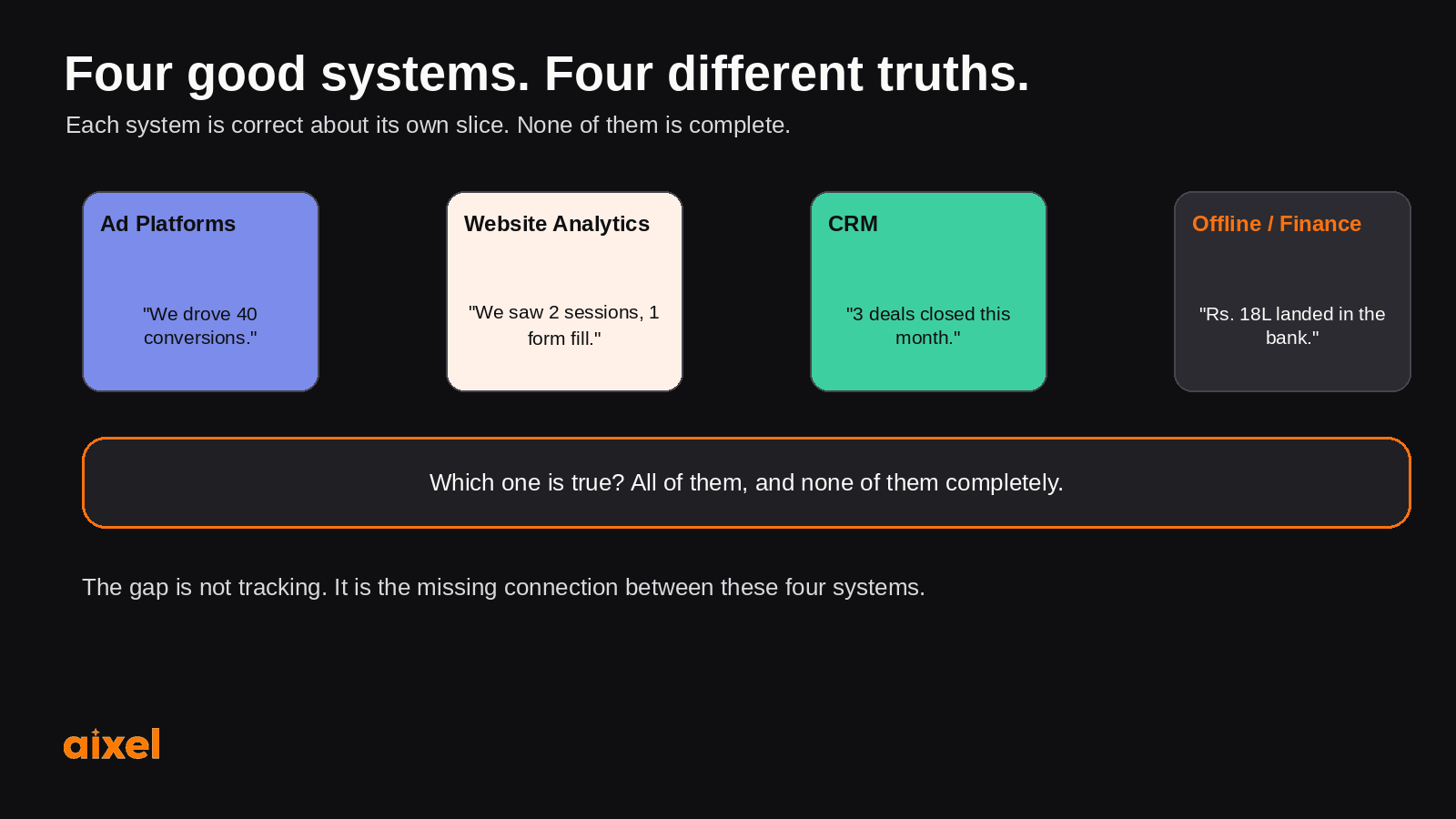
The ad platform says how many clicks and conversions it drove. The website analytics tool says how many sessions and events happened. The CRM says which leads turned into deals. The offline system, whether that is a POS, a payment gateway or a finance sheet, says how much revenue actually landed.
Each one is correct, on its own terms. None of them is complete.
A marketing lead pulls up the ad platform on a Monday and a CRM export on a Tuesday, and spends Wednesday trying to make the two numbers agree. A founder asks “which channel is actually driving revenue” and gets four different answers depending on who is asked and which tool they opened. A growth team ships a new landing page, watches sessions and form fills go up, and still cannot say whether that translated into paid customers three weeks later.
This is not a tracking problem. It is not solved by installing one more pixel or connecting one more integration.
It is a structural problem: the business has four separate systems, each holding one piece of the customer journey, with no shared layer connecting them.
The question every measurement stack eventually has to answer
Most businesses start with a simpler question: “Can we track this channel?”
Website analytics answers that for the site. A pixel or a Conversions API integration answers that for ads. WhatsApp Business tools answer that for conversations. A CRM answers that for the sales pipeline.
But as the business grows, the real question changes. It stops being about any one channel and becomes:
Can we connect a single customer's journey across every one of these systems, from first touch to the revenue they eventually generated?
That is a materially harder question, because it requires the systems to share an identity, not just report their own events.
We have written before about why marketing attribution breaks across Meta, Google, TikTok, CRM and WhatsApp, why Conversions API changed how server-side tracking works, and how WhatsApp conversations need to be connected to CRM stages and revenue. Each of those is one piece of the same underlying gap. This post is about the layer that sits underneath all three: the connective tissue that makes any of that unification possible in the first place.
A journey that already happened to one of your customers
Picture a real path a customer might take.
They see a Meta ad and click through to a landing page. They browse for a few minutes, leave, and come back two days later through a Google search. This time they fill out a form. A salesperson follows up over email, then the conversation moves to WhatsApp because the customer has more questions. A quote goes out. The customer asks for a discount, gets a revised quote, and disappears for a week. Then they call the sales number directly, agree to the deal, and pay by bank transfer three days later.
Now ask: which channel gets credit for that customer?
The ad platforms only see the clicks. The website analytics tool sees two sessions with a form fill in between, but does not know what happened on WhatsApp or on the phone. The CRM sees a lead, a quote, a stall, and eventually a closed-won deal, but its “lead source” field was set once, at creation, and never updated as the story evolved. The offline payment shows up in a bank statement or a finance tool that has no idea any of this marketing activity ever happened.
Every system has a fragment. No system has the story.
That is what a unified measurement layer is for: not a new dashboard, but a shared identity and event history that lets every one of those fragments be reassembled into the one journey the customer actually experienced.
Why four good systems still produce four different truths
None of the individual tools are doing anything wrong. The disconnect happens at the seams between them, for a few specific reasons.
The Seams Where Data Breaks
- Different identifiers. The ad platform knows a click ID. The website knows a client ID or a cookie. The CRM knows an email or a phone number. The offline system knows a bank reference or an invoice number. Nothing forces these identifiers to map to each other unless a business deliberately builds that mapping.
- Different timeframes. A click happens in a second. A CRM deal can take weeks to close. An offline payment can land a month later. Systems that are only built to report their own events have no way to wait for, or retroactively credit, an outcome that happens somewhere else, later.
- Different definitions of “conversion.” Ads platforms often optimize on the earliest signal they can get, like a form submission or a chat start. The business usually cares about a much later signal, like a signed deal or a payment received. Left alone, ad platforms optimize for the wrong end of the funnel, because that is the only end they can see.
- No agreed single owner of the record.When a customer's lead source, deal stage and revenue outcome each live in a different tool with no reconciliation process, the business ends up with three or four partial answers to the same question, and picks whichever one is convenient in a given meeting.
This is why buying more tools rarely solves the problem. Adding another dashboard on top of four disconnected systems produces a fifth number to reconcile, not an answer.
What “unified measurement layer” actually means
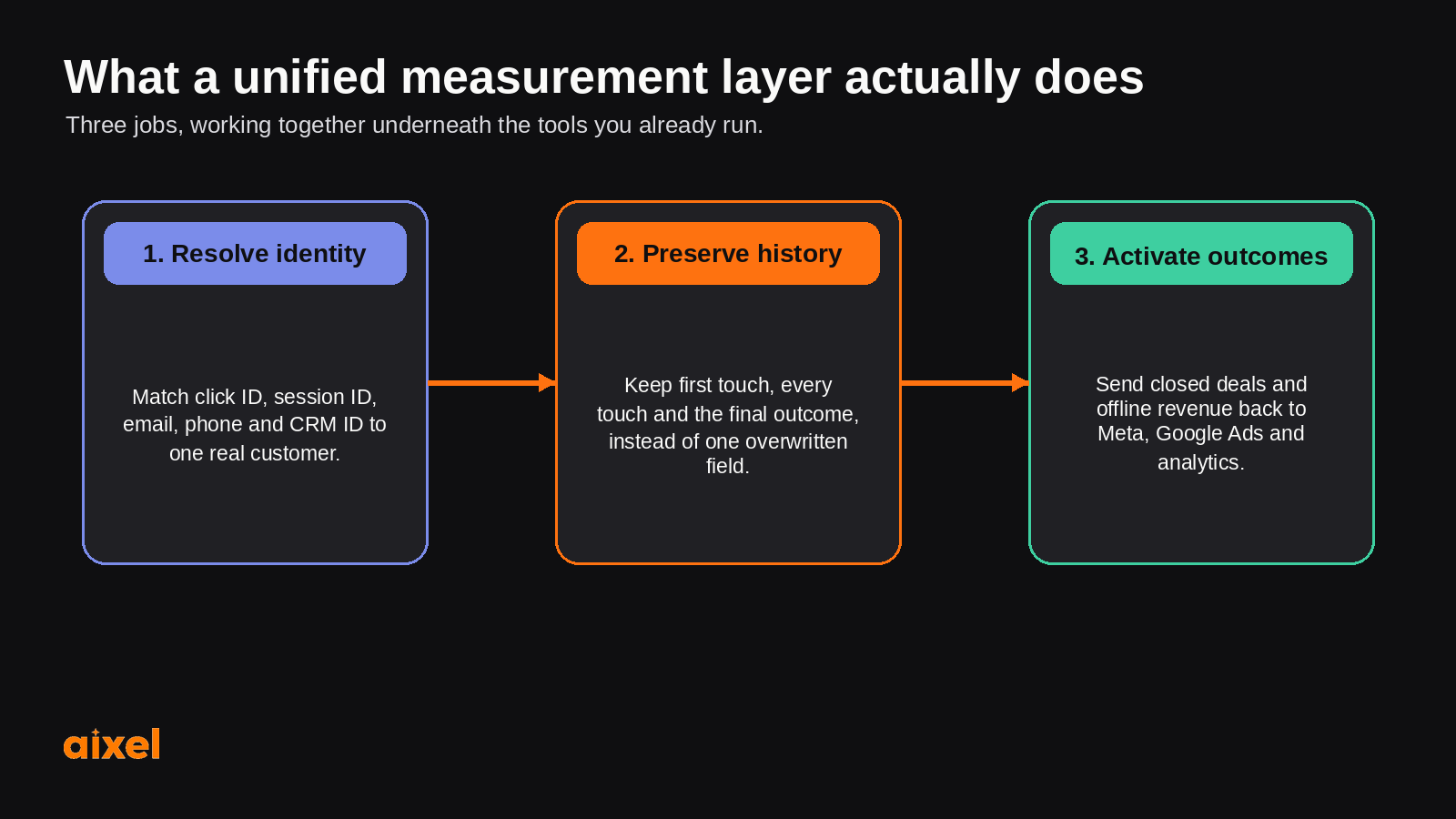
A unified measurement layer is the connective layer that sits underneath the tools a business already uses. It does three specific jobs:
- Resolves identity. It takes the different identifiers each system uses, such as a click ID, a session ID, an email, a phone number or a CRM lead ID, and links them to the same underlying person wherever a deterministic match exists (the same email used on a form and in the CRM, the same phone number used on WhatsApp and in a payment record). Identity resolution is the term the customer data platform industry uses for exactly this matching process, and deterministic matching, which relies on exact identifiers rather than statistical inference, is the version that holds up to privacy and accuracy scrutiny.
- Preserves history instead of overwriting it.Instead of a CRM field that only stores “lead source” once, the layer keeps first touch, every subsequent touch, and the final outcome, so that a journey which spans two weeks and four channels does not collapse into whichever channel happened to be first or last.
- Sends outcomes back to where they can be used. Once a deal closes or an offline payment lands, that outcome is only useful if it reaches the systems that can act on it: back to Meta through the Conversions API, back to Google Ads through offline conversion import or enhanced conversions for leads, and back to analytics through tools like GA4 Data Import, so that reporting and bidding both reflect what actually happened, not just what happened first. (Note that for health, wellness, and sensitive category brands on Meta, those payloads must be sanitized through a neutral taxonomy first to prevent policy rejections — see our breakdown: Meta Health and Wellness Restrictions in 2026.)
This is close to what the data industry calls reverse ETL: moving clean, resolved customer data out of wherever it is unified and back into the operational tools, like ad platforms and analytics, that need it to act. The label matters less than the outcome: one identity, one history, and a path for outcomes to reach the platforms making decisions.
The four building blocks in practice
Strip away the vendor terminology and a working measurement layer needs four concrete things.
1. A shared identifier strategy
Decide, in advance, which identifiers will be captured and stored at every touchpoint: click IDs on ad clicks, a client or session ID on the website, email and phone on forms and WhatsApp, and a reference ID on offline payments. None of the unification work below is possible if these identifiers are not captured consistently from day one.
2. Event capture across every channel that matters
Website behavior, ad clicks, WhatsApp conversation starts and outcomes, CRM stage changes and offline revenue events all need to be recorded as events tied to the shared identifiers from block one. This does not require tracking everything; it requires tracking the handful of moments that mark a real change in the customer's status.
3. A connective layer that resolves and stores the identity
This is the actual unification step: matching the identifiers from block one, using deterministic rules rather than guesses, into one profile per customer, and keeping the full event history against that profile rather than a single “source” snapshot.
4. Activation back into ad platforms and analytics
A resolved profile that never leaves the layer it lives in has no effect on marketing performance. The value comes from feeding the qualified outcomes back out: CRM-sourced offline events into Meta through Conversions API for CRM integrations, closed deals into Google Ads through offline conversion import, and the same resolved history into GA4 or whatever analytics tool the team already reports from.
Where this typically breaks
A few patterns show up repeatedly in stacks that look sophisticated on paper but still cannot answer “which channel drove this revenue.”
Common Breakdown Patterns
- Identifiers are captured inconsistently. A form captures email but not the click ID. A WhatsApp conversation captures a phone number but nothing about how the conversation started. Each gap in capture is a break in the chain that cannot be repaired after the fact.
- Lead source gets overwritten. Many CRMs store a single lead source field, set at creation and never revisited. A customer who returns through a second channel before converting gets full credit assigned to whichever channel happened to create the record, which is often not the channel that actually closed the deal.
- Offline revenue never reaches the ad platforms. Sales that close over a call, in person, or through a bank transfer are recorded in a CRM or a finance tool and stop there. Meta and Google keep optimizing toward the earliest online signal they can see, because they are never told what happened after.
- The CRM and the ad account are treated as separate reporting worlds. Marketing looks at ad platform dashboards. Sales looks at CRM pipeline reports. Nobody owns the reconciliation between the two, so both teams operate on partial information and disagree about which channels are “working.”
- Unification is attempted as a one-time export instead of an ongoing connection. A single CSV upload of closed deals into an ad platform helps for a month. Without an ongoing, automated sync, the gap reopens as soon as the spreadsheet goes stale.
How Aixel builds this layer
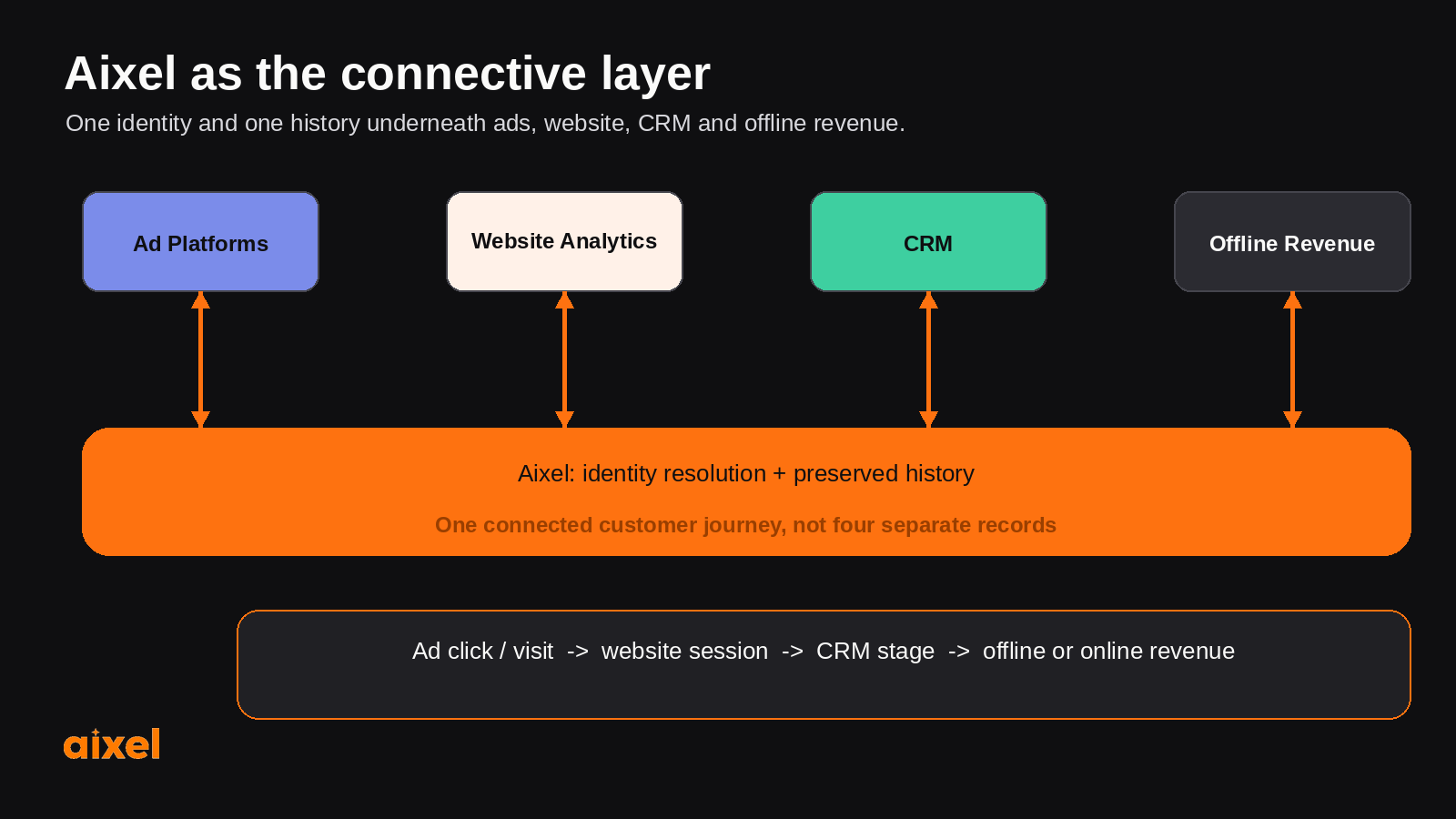
Aixel's role is to be the connective layer underneath the tools a business already runs, not another dashboard next to them.
When a visitor lands on the website from an ad, Aixel preserves the click and session identifiers. When that visitor fills a form or starts a WhatsApp conversation, Aixel links the new identifiers, like email or phone, back to the same profile. When a salesperson moves the record through CRM stages, Aixel keeps that update attached to the same journey rather than starting a new one. When a deal closes or an offline payment is confirmed, Aixel can send that outcome back out through server-side channels, Conversions API and offline conversion import, so that Meta, Google and the team's own reporting reflect the revenue that actually happened.
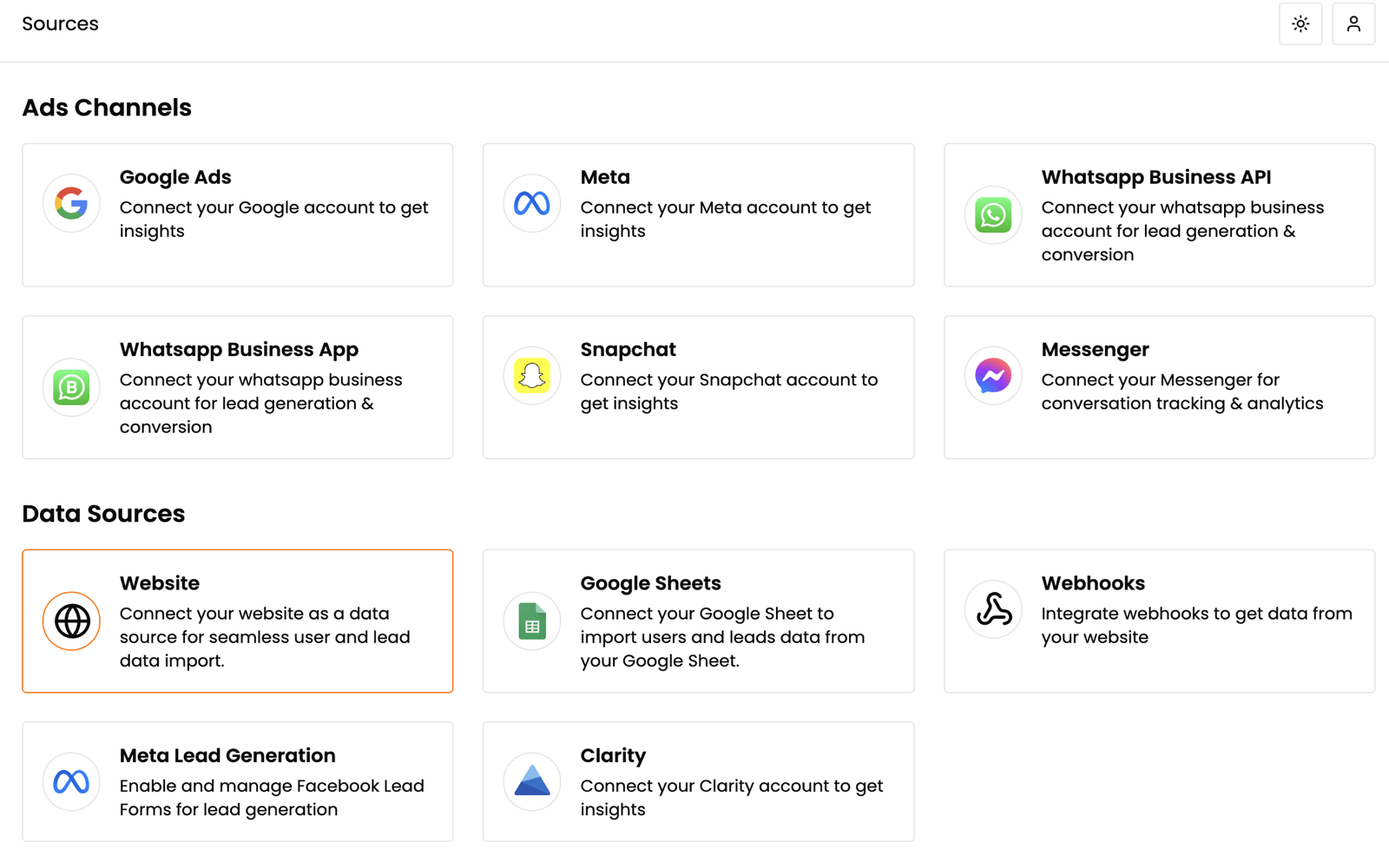
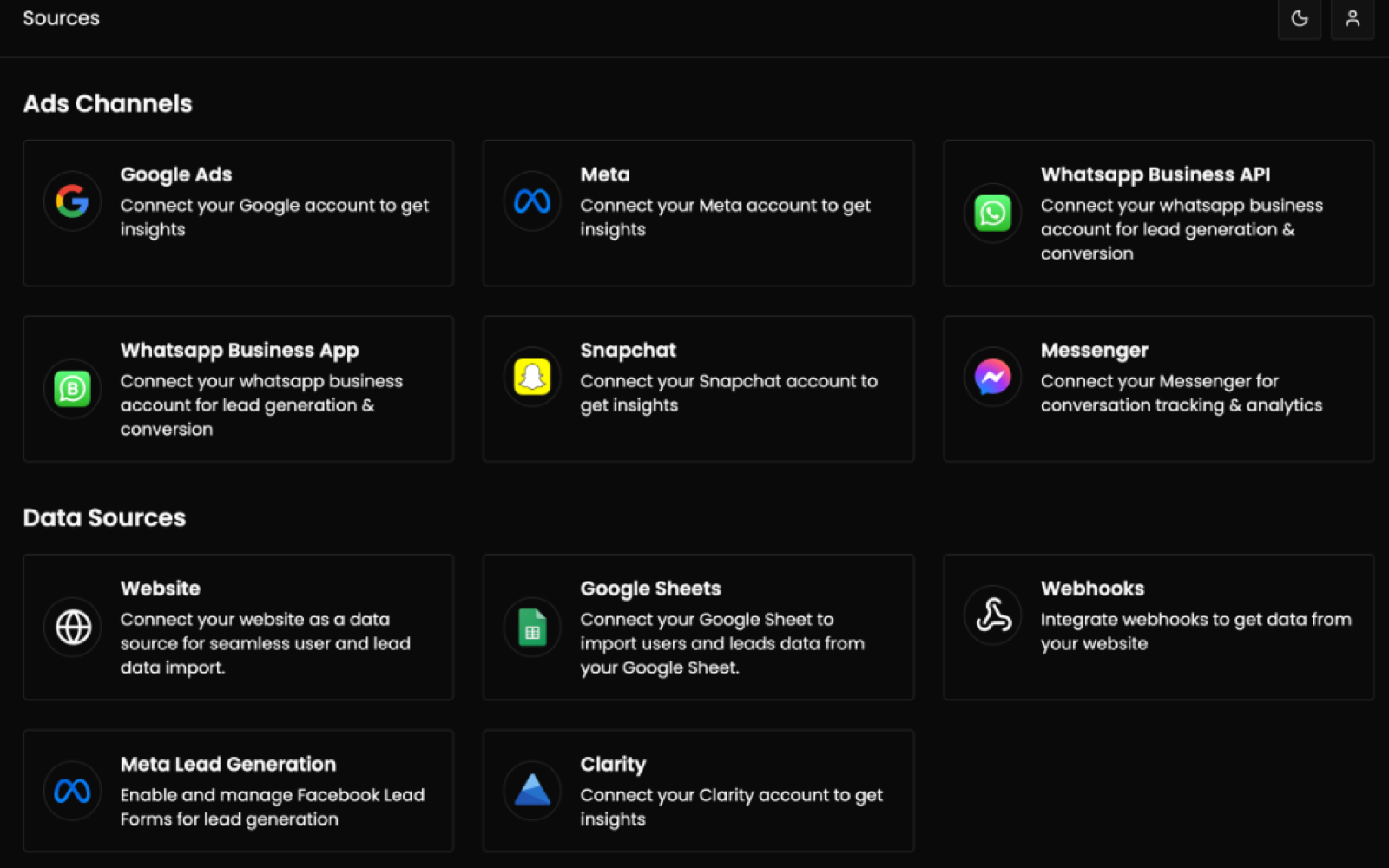
In practice, this starts with connecting the sources themselves. Aixel's integrations cover both sides of the journey described in this post: ad channels like Google Ads, Meta and the WhatsApp Business API on one side, and data sources like the website, CRM webhooks and Google Sheets on the other, so that identity resolution has real, first-party data to work with rather than a single channel's view.
The result is one connected line:
instead of four disconnected records that a person has to reconcile by hand every week.
A practical rollout model
Building this does not require replacing any existing tool. It requires sequencing the work correctly.
- Audit what identifiers are captured today. Check whether click IDs, session IDs, email and phone are actually being captured and stored at each touchpoint: ad clicks, website forms, WhatsApp entry points, and CRM records. Most gaps start here.
- Fix capture gaps before building anything else. There is no unification step that can recover an identifier that was never captured. This is unglamorous work, but it is the foundation everything else depends on.
- Pick the deterministic matching rules. Decide which identifiers are strong enough to link two records with confidence, typically exact email or phone matches, rather than relying on inferred or probabilistic matching that introduces false positives into revenue reporting.
- Preserve full history, not a single snapshot. Store first touch, every subsequent touch, and the final outcome against one profile, so a multi-channel, multi-week journey does not collapse into a single, possibly misleading, “source” field.
- Automate the outcome sync back out. Move from manual CSV uploads to an ongoing, automated connection back into Meta Conversions API, Google Ads offline conversion import or enhanced conversions for leads, and analytics data import, so the loop stays current as new deals close.
- Review channel performance against the unified view, not the platform view. Once outcomes flow back, evaluate channels by the revenue and qualified deals they actually produced, not by the earliest click or session the ad platform happened to see.
Common mistakes
- Buying another analytics or reporting tool instead of fixing identity capture at the source.
- Treating the CRM's original “lead source” field as final, even after a customer returns through a different channel.
- Sending only the earliest signal, like a form fill or chat start, back to ad platforms and never following up with the real outcome.
- Running offline conversion imports as a one-off spreadsheet exercise rather than an ongoing sync.
- Assuming probabilistic or inferred matching is good enough for revenue-level reporting, when deterministic matches are available and more defensible.
- Letting marketing and sales operate from separate, unreconciled views of the same customers.
The Aixel Point of View
A business does not have a shortage of data. It has a shortage of connection between the data it already collects.
The ad platform, the website, WhatsApp, the CRM and the finance system each do their individual job well. What is usually missing is the layer that takes what each of them already knows and turns it into one journey, with one identity and one history, that can be measured and fed back to the systems making decisions.
That is not a reporting problem to be solved with another chart. It is a connection problem, and it has a specific, buildable answer: capture the right identifiers consistently, resolve them deterministically, keep the full history, and send outcomes back to where they can change what the ad platforms optimize for.
The question worth asking is not: “Which tool should we buy next?”
It is: “Do we have one connected view of the customer across web, CRM, WhatsApp and offline revenue, or four separate ones that happen to be about the same person?”
Frequently asked questions
Is a unified measurement layer the same thing as a customer data platform?
They overlap. A customer data platform is typically the software category that performs identity resolution and stores unified profiles. A unified measurement layer is the outcome a business needs: identity resolution, preserved history and outcome activation working together, regardless of which specific tool provides it.
Do we need a full data warehouse to do this?
Not necessarily. Some businesses build this on a data warehouse with reverse ETL tooling; others use a purpose-built layer, like Aixel, that handles identity resolution and activation directly without requiring a warehouse build-out first. The warehouse is one way to get there, not a requirement.
What is the difference between deterministic and probabilistic matching, and does it matter here?
Deterministic matching links records using exact identifiers, such as the same email or phone number appearing in two systems. Probabilistic matching infers a likely match from indirect signals. For revenue-level reporting and ad platform optimization, deterministic matching is the safer standard, since it does not introduce guesswork into numbers a business will act on.
How does this connect to Conversions API and offline conversion imports?
Conversions API and offline conversion imports are the activation half of the layer: the mechanism for sending resolved, qualified outcomes, like a closed CRM deal or an offline payment, back to Meta and Google Ads so the platforms can optimize toward what actually converts, not just the earliest online signal.
Does WhatsApp fit into this the same way as web and CRM?
Yes. A WhatsApp conversation is another touchpoint that needs its entry point, its identifiers and its outcome connected to the same profile as the rest of the journey, the same way a website session or a CRM stage change would be. For operational workflow, see WhatsApp Is Your Sales Floor, and for the technical click token (ctwa_clid) and Conversions API integration, read The WhatsApp Conversions API Guide.
How long does it take to build this?
The identifier audit and capture fixes can often happen in weeks. The bigger time investment is usually organizational: getting marketing, sales and finance to agree on one shared view of the customer, rather than three separate ones.
Ready to recover your attribution signal?
Connect Meta, Google, TikTok, and WhatsApp in one platform. No code required.
Get started free
