

Growth teams often use the terms pixel, Conversion API, and server-side tracking as if they mean the same thing. They do not.
A pixel is usually a browser-side tag that observes website behavior. A Conversion API is an ad-platform endpoint that receives conversion events directly from a business or its measurement partner. Server-side tagging, in the Google and Meta setup language most growth teams use, is mainly a web-event routing pattern: the browser sends events to a first-party server endpoint, and that server forwards the event to Google, Meta, TikTok or another destination with more control.
The difference matters because modern performance marketing does not fail only because one tag is missing. It fails because customer journeys now move across browsers, apps, CRMs, offline sales, WhatsApp, Instagram, payment systems and ad platforms. A browser pixel can see part of that journey. Server-side tagging can make browser-originated web events more durable and controlled. Conversion APIs and offline conversion import workflows are what send CRM, WhatsApp, offline and down-funnel outcomes back to ad platforms.
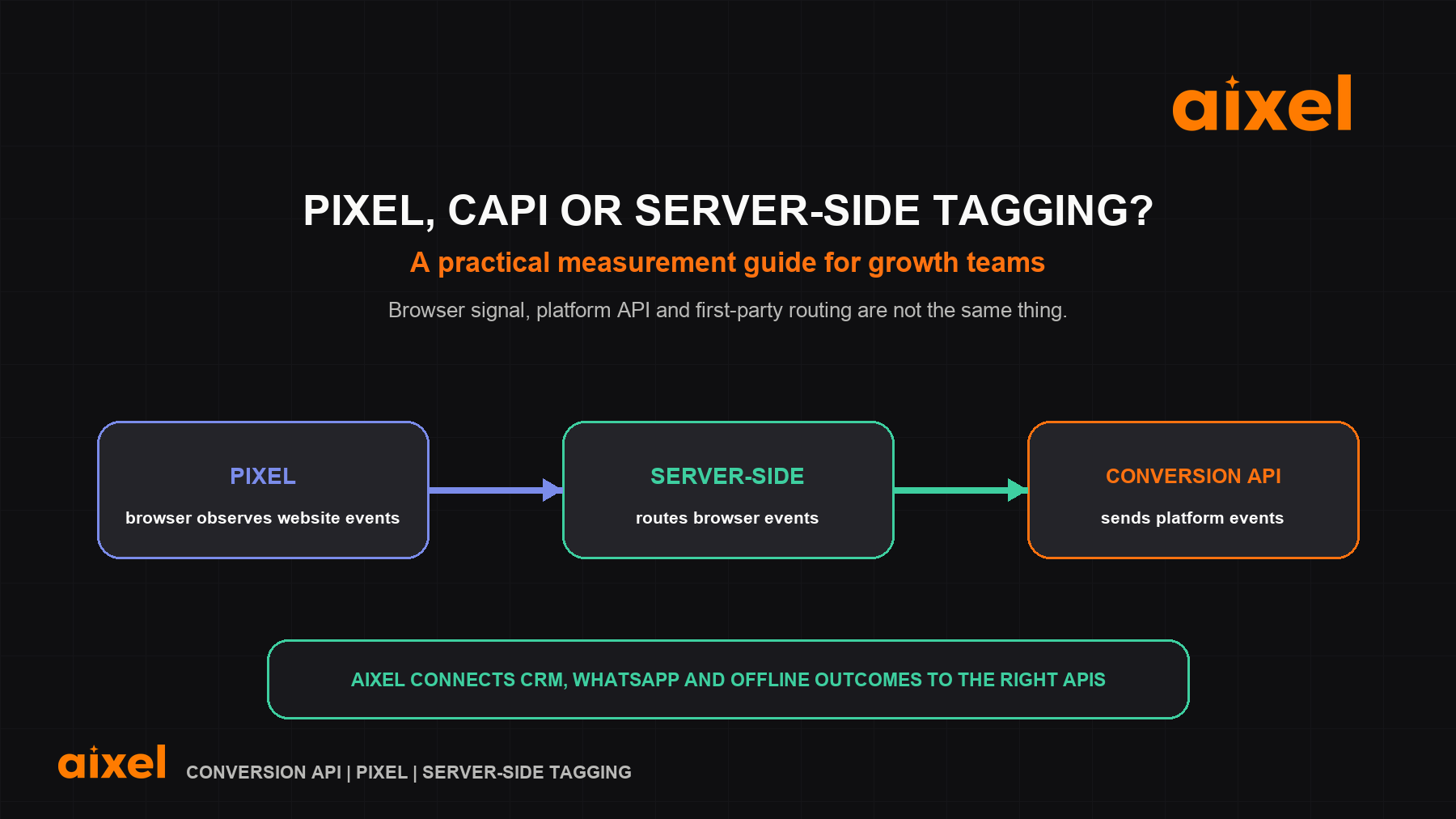
A pixel observes the browser, server-side tagging routes browser events through a first-party server endpoint, and Conversion APIs or offline import APIs send server-known outcomes to ad platforms.
For Aixel, this distinction is important. Aixel is not just a tag installer. It helps growth teams unify first-party data across ads, website, CRM, ecommerce and messaging journeys, then push cleaner conversion signals into destinations such as Meta, Google and TikTok.
Quick definitions
What is a pixel?
A pixel is a small piece of browser-side code placed on a website. It sends website events to a platform when a visitor views a page, adds to cart, starts checkout, submits a lead form or purchases.
The Meta Pixel documentation describes it as JavaScript code that tracks visitor activity on a website. TikTok says its Pixel is website code that shares website events with TikTok and helps measure traffic, campaign performance and optimization. In practice, pixels are easy to deploy and useful for basic measurement, retargeting and campaign learning.
But pixels depend heavily on the browser. That makes them vulnerable to ad blockers, browser privacy controls, page-load issues, consent choices, tag misfires, duplicate scripts and missing checkout or CRM events.
What is a Conversion API?
A Conversion API is a server-to-platform connection. Instead of relying only on the browser to send the event, your server or measurement partner sends conversion data directly to the ad platform.
Meta's Conversions API is designed to connect advertiser marketing data, including website, app, offline, CRM and business messaging events, to Meta systems. TikTok's Events API gives advertisers a connection between TikTok and their marketing data across web, app and offline channels such as store and CRM. Google does not call its equivalent “CAPI”; for Google Ads, offline and down-funnel outcomes usually move through enhanced conversions for leads, offline conversion imports, Google Ads API or Data Manager workflows.
Conversion APIs are usually platform-specific. Meta CAPI sends events to Meta. TikTok Events API sends events to TikTok. Google enhanced conversions and offline conversion imports send signals to Google. They improve platform signal quality, but each one still sees the world through that platform's measurement model.
What is server-side tracking?
Server-side tracking, more precisely server-side tagging, is not a separate ad-platform destination in the same way Meta CAPI or TikTok Events API is. In the Google Tag Manager model, it uses two containers: a web container on the website or app and a server container in a cloud environment. The web container monitors user interactions and dispatches HTTP requests; the server container accepts those requests, applies processing rules, and sends data to Google products or third-party endpoints.
That means server-side tagging is mostly about browser-originated or app-originated events taking a different route. Instead of the browser calling every ad platform directly, the browser can send fewer requests to a first-party server endpoint, often on a custom subdomain. That server can validate, redact, normalize and forward the event. It can also load some Google scripts in a first-party context through Google tag gateway for advertisers.
This is where Aixel fits best: Aixel's features and integrations are about connecting fragmented first-party data, not simply firing one more tag.
The core difference
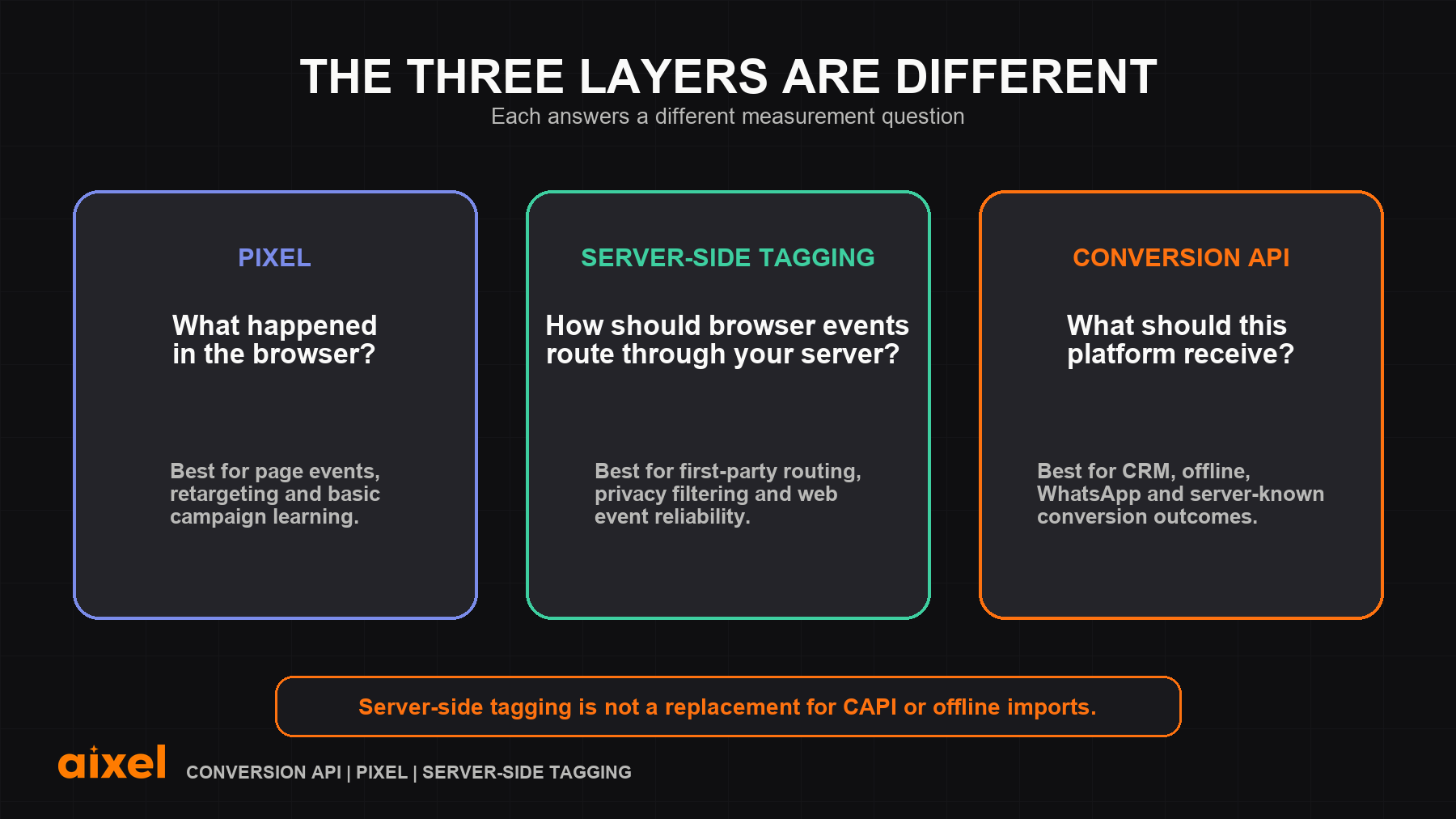
Think of the three layers like this:
- Pixel: “What happened in the browser?”
- Conversion API: “What conversion event should this ad platform receive?”
- Server-side tagging: “How should browser-originated events be routed through a first-party server endpoint?”
That sounds subtle, but it changes how growth teams diagnose measurement problems.
If the Meta Pixel misses a purchase because the checkout page did not load correctly, a Meta CAPI setup may recover that Meta event. If Google Ads is missing CRM-qualified leads, enhanced conversions for leads or offline conversion imports may help Google connect the lead back to the original ad interaction. If TikTok is underreporting conversions because browser connectivity is inconsistent, TikTok Events API can improve the signal.
But if your issue is that one user clicked a Google ad, entered WhatsApp, was qualified in CRM, later purchased offline, and then every channel reported a different version of the journey, server-side tagging alone does not solve it. You need first-party attribution that preserves the journey, plus the correct platform APIs or import workflows to send those down-funnel outcomes back.
Why pixels alone are no longer enough
Pixels are still useful. The mistake is treating them as the entire measurement system. Browser-side tracking can fail for several reasons:
- The page does not fully load before the user leaves.
- Consent settings prevent tags from firing.
- Ad blockers block third-party scripts or network calls.
- Browser privacy controls limit cross-site tracking.
- Checkout or payment pages sit on another domain.
- Events happen in CRM, WhatsApp, phone calls, sales teams or offline systems, outside the browser.
- Multiple tags fire the same event and create duplicates.
- Platform attribution windows disagree with each other.
WebKit's tracking prevention documentation explains that Safari/WebKit includes tracking prevention technologies such as Intelligent Tracking Prevention and a default cookie policy that limits third-party cookie behavior. Google has also continued to change Chrome's privacy direction; in 2025 it said it would maintain its current approach to third-party cookie choice rather than roll out a new standalone prompt, and later announced the retirement of several Privacy Sandbox technologies while continuing work on narrower privacy and identity APIs.
The takeaway is not “cookies are dead tomorrow.” The takeaway is sharper: browser-only measurement is unstable because browsers, users, consent rules and platform policies all influence what the pixel can observe.
Where Conversion APIs help
Conversion APIs help ad platforms receive events that are more durable than browser-only signals.
Meta CAPI, TikTok Events API and Google enhanced conversions all exist because platforms need better conversion evidence for measurement, optimization and bidding. TikTok explicitly says Events API can improve ad delivery and targeting by capturing missing conversions when connectivity issues and browser inconsistency affect Pixel-reported conversions. Google says enhanced conversions can improve conversion measurement by sending hashed first-party data from website tags or imported offline events.
For growth teams, that means Conversion APIs and offline import workflows are valuable when:
- Purchases, leads or qualified events are missing from ad platform reports.
- Browser tags are blocked or inconsistent.
- Offline, CRM or messaging outcomes need to be sent back to Google, Meta or TikTok.
- You want better match quality using first-party customer data.
- You need deduplication between browser and server events.
- Your campaigns need stronger conversion feedback for bidding and optimization.
The best implementations usually combine browser signal and platform API signal. TikTok recommends using Events API with an existing Pixel integration for website connections. Meta implementations commonly pair browser Pixel events with server events and deduplicate them using shared event IDs. Google server-side tagging can route web conversion tags through a server container, while enhanced conversions for leads and offline imports handle lead and sales outcomes that happen after the website.
An online pharmacy used this exact approach to rebuild compliant Meta conversion feedback after policy restrictions broke their tracking. (For the complete breakdown of Meta's 2026 health restrictions, PII/PHI rules, and sanitization pipelines, see our guide: Meta Health and Wellness Restrictions in 2026.)
Where Conversion APIs do not solve everything
Conversion APIs are powerful, but they are not magic. A server event sent to one ad platform does not automatically create a single source of truth across the business.
A Conversion API usually does not solve:
- Which channel should get credit when Meta, Google and TikTok all influenced the same buyer.
- Whether a WhatsApp conversation became a qualified lead in CRM.
- Whether a purchase was refunded, canceled or duplicated.
- Whether the same event was sent twice under different names.
- Whether the event taxonomy is consistent across platforms.
- Whether finance, sales and marketing agree on revenue.
- Whether consent rules allow the event to be shared with a destination.
That is why CAPI should not be treated as “server-side tracking,” and server-side tagging should not be treated as a replacement for CAPI or offline conversion imports. They solve different parts of the measurement problem.
For why this fragmentation happens across every channel, not just CAPI, see Why Marketing Attribution Breaks Across Meta, Google, TikTok, CRM and WhatsApp.
Server-side tagging is not the same as CAPI
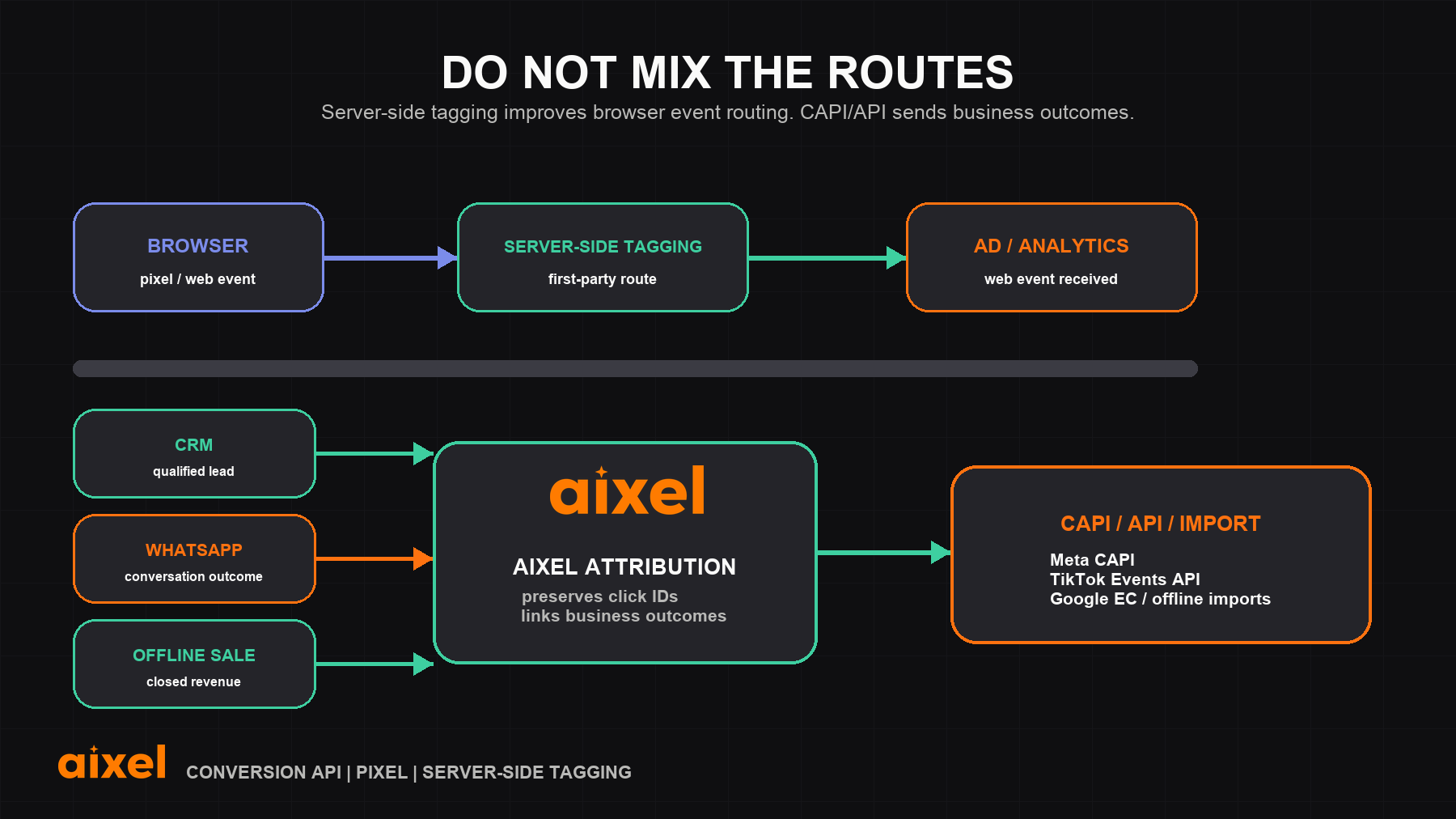
This is the correction many teams miss.
Server-side tagging improves the web-event route
Server-side tagging is useful when the event starts in the browser or app. The browser sends the event to a first-party endpoint, often a subdomain such as metrics.example.com. The server endpoint can then forward the event to Google, Meta, TikTok, analytics or another destination.
That can improve control, reduce direct third-party calls from the browser, reduce client-side processing, support privacy filtering, and improve data quality. It can also help when browser-to-third-party requests are blocked or degraded.
CAPI and offline imports send server-known outcomes
CRM updates, WhatsApp-qualified leads, phone sales and offline purchases are different. They do not originate as clean browser page events. They live in business systems. To send them to ad platforms, you need the right destination path:
- Meta Conversions API for offline, CRM and business messaging events.
- TikTok Events API for offline and CRM events.
- Google enhanced conversions for leads, offline conversion imports, Google Ads API or Data Manager.
Aixel should be positioned here: not merely as "server-side tracking," but as the first-party attribution and conversion feedback layer that connects website click IDs, WhatsApp conversations, CRM outcomes and platform APIs. That means Aixel can preserve the click identity, connect it to the WhatsApp and CRM journey, then send the qualified conversion back through the correct destination workflow.
A practical example
Imagine a buyer sees a TikTok ad, later searches on Google, clicks a paid search ad, lands on the site, opens WhatsApp, speaks to sales, and then purchases after a CRM follow-up.
The pixel-only view may say:
- TikTok saw an engaged visitor.
- Google saw a click and maybe a page event.
- The website saw a WhatsApp button click.
- CRM saw the sale.
- None of the ad platforms saw the full outcome.
The API feedback view improves part of the picture:
- TikTok can receive web, app, offline or CRM events through Events API.
- Google can receive enhanced conversions or offline lead conversions.
- Meta can receive website, CRM, offline or business messaging events through Conversions API, depending on setup.
The Aixel first-party attribution view connects the business truth:
- The original click IDs are preserved.
- The WhatsApp handoff is linked to the website session. This WhatsApp handoff is covered in depth in WhatsApp Is Your Sales Floor, and the technical API reporting mechanics (
ctwa_clid) are detailed in The WhatsApp Conversions API Guide. - The CRM sale is matched to the original journey.
- Duplicate events are collapsed.
- The right conversion signals are sent back to the right ad platforms.
- Marketing sees one governed revenue record instead of three dashboard stories.
This is why Aixel's messaging and CRM attribution matters. In many businesses, the most important conversion does not happen on a clean thank-you page. It happens after a conversation.
Which setup do you need?
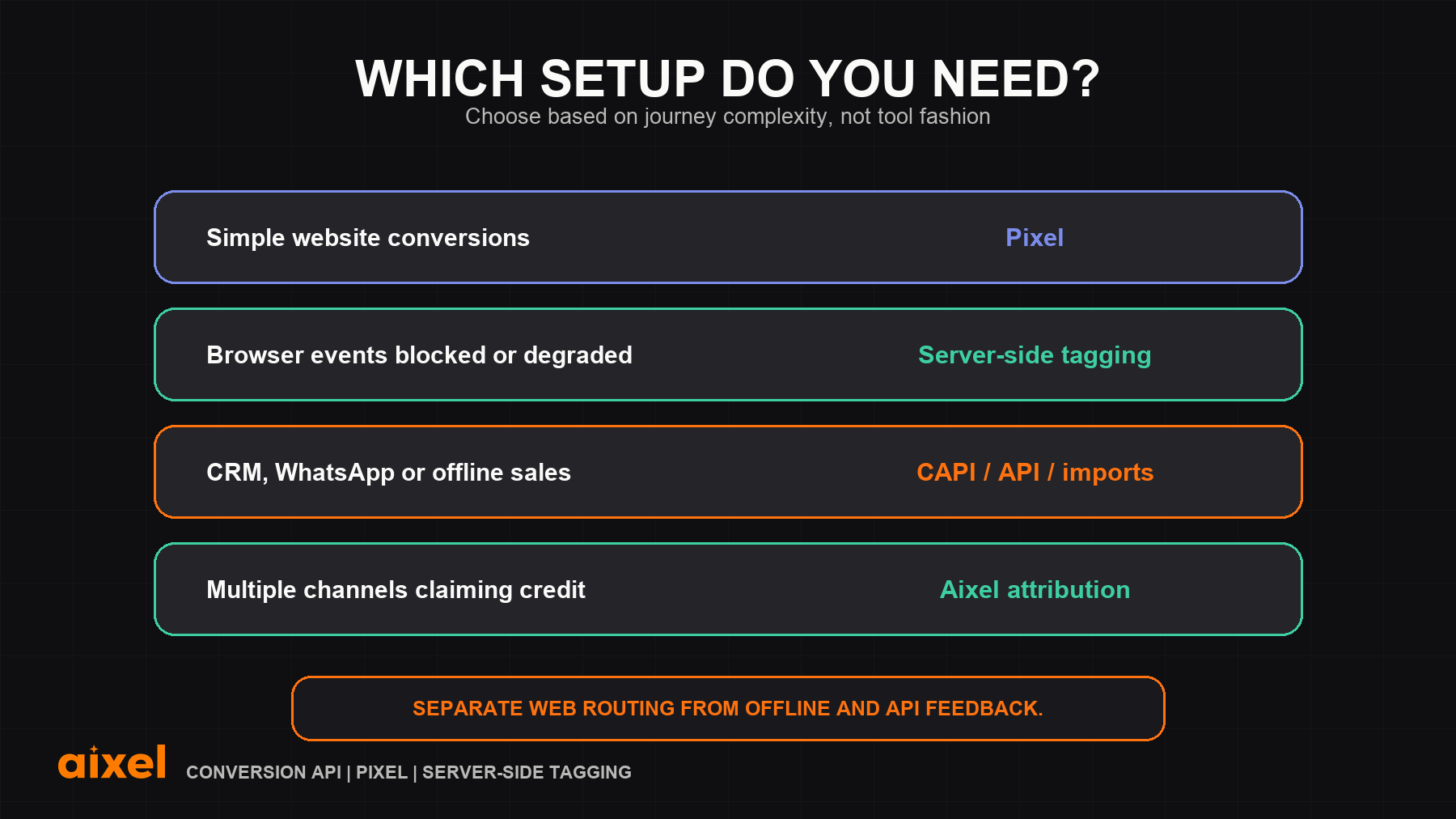
For most serious growth teams, the answer is not either/or. It is a layered setup:
- Use a pixel-only setup if you are early-stage, have simple website conversions, do not depend heavily on CRM or messaging, and mainly need basic retargeting and campaign learning.
- Use a pixel plus Conversion API setup if you already spend meaningfully on Meta, Google or TikTok and need better conversion signal quality, better match rates, and fewer missing browser or platform events. Keep browser pixels for useful client-side context.
- Use server-side tagging if your main problem is browser-event reliability, direct browser-to-vendor calls, client performance, privacy filtering or first-party routing for website/app events.
- Use first-party attribution plus CAPI/API feedback if your customer journey crosses website, ecommerce, CRM, WhatsApp, offline sales or multiple ad platforms, and the business needs one trusted conversion record that can be routed into Meta CAPI, TikTok Events API, Google enhanced conversions or offline-import workflows.
Implementation checklist
Before implementing CAPI or server-side tracking, align on these decisions:
- Event taxonomy: Which events matter: page view, lead, add to cart, purchase, qualified lead, closed won, refund?
- Source identity: Which click IDs and source parameters must be preserved: GCLID, FBCLID, TTCLID, UTM, campaign ID?
- Customer identity: Which first-party identifiers can be used with consent: email, phone, customer ID, order ID?
- Deduplication: Which event ID or order ID prevents browser and server events from double counting?
- Destination rules: Which events should go to Meta, Google, TikTok, analytics, CRM or warehouse?
- Consent and policy: What can be collected, stored, hashed and shared in each region?
- Validation: How will you test event receipt, match quality, duplicate rate and platform diagnostics?
- Business reconciliation: Does marketing revenue match ecommerce, CRM and finance after refunds and cancellations?
Skipping this planning is how teams end up with a technically active CAPI setup that still does not fix attribution.
Common mistakes
- Mistake 1: Calling CAPI "server-side tracking." A Conversion API is a destination API for sending events to a platform. Server-side tagging is mainly a first-party routing pattern for browser or app events. They can work together, but they are not the same thing.
- Mistake 2: Sending every event everywhere. More data is not always better. Platforms need useful, consented, deduplicated events that map to real business value.
- Mistake 3: Forgetting deduplication. If the browser and server send the same purchase without a shared event ID, reporting can inflate.
- Mistake 4: Optimizing for clicks instead of qualified outcomes. A lead event is not the same as a sales-qualified lead, and a WhatsApp start is not the same as revenue.
- Mistake 5: Expecting server-side tagging to solve CRM and messaging. For many brands, the most valuable conversion happens after the website. If CRM and WhatsApp are missing, server-side tagging will not magically recover them; you need attribution plus CAPI/API feedback.
- Mistake 6: Treating privacy as a technical afterthought. Hashing, consent, minimization and destination rules need to be part of the design from the start.
How Aixel fits
Aixel helps growth teams move from fragmented tags to unified first-party attribution and conversion feedback. That means Aixel can help:
- Connect website events, ad click IDs, ecommerce orders, CRM outcomes and WhatsApp journeys.
- Preserve source identity from click to conversation to conversion.
- Normalize event names and business definitions.
- Deduplicate browser, backend and CRM outcomes where needed.
- Push cleaner conversion signals into Meta CAPI, TikTok Events API, Google enhanced conversions and offline import workflows.
- Give marketing, sales and finance a more trustworthy view of CAC, ROAS and revenue.
The outcome is not just “better tracking.” It is better decision-making. Campaigns learn from real outcomes, teams stop fighting over dashboard discrepancies, and growth operators can see which channels create customers rather than only clicks.
This is one piece of a larger connective layer — see The Unified Measurement Layer for the complete model.
FAQ
- Is a Conversion API better than a pixel?
- It is not simply better; it solves a different problem. A pixel observes browser-side behavior. A Conversion API sends events from your server or measurement partner to an ad platform. Most mature setups use both, with deduplication.
- Does server-side tracking bypass privacy rules?
- No. Server-side tracking does not remove the need for consent, policy compliance or data minimization. It gives you more control over what is collected, transformed and shared.
- Do I need Meta CAPI, Google enhanced conversions and TikTok Events API?
- If you spend meaningfully across all three platforms, probably yes. But they should be implemented through a governed measurement model rather than as three disconnected projects.
- Can server-side tagging fix CRM or WhatsApp attribution?
- Not by itself. Server-side tagging can improve how web events are routed from the browser to vendor endpoints. CRM and WhatsApp attribution requires preserving click IDs and first-party identity across the journey, then sending qualified outcomes back through Meta CAPI, TikTok Events API, Google enhanced conversions or offline import workflows.
- Can server-side tracking fix ROAS mismatch?
- It can reduce mismatch for browser events by improving event routing, validation and control. For CRM, WhatsApp and offline revenue mismatch, the bigger fix is first-party attribution plus platform API feedback. Even then, every platform still applies its own attribution model and reporting rules.
- Where should a growth team start?
- Start with your highest-value conversion event and the biggest measurement gap. For ecommerce, that may be purchase reconciliation. For lead-gen and service businesses, it may be website to WhatsApp to CRM attribution. Then expand into platform APIs and audience activation.
Ready to recover your attribution signal?
Connect Meta, Google, TikTok, and WhatsApp in one platform. No code required.
Get started free
