

The New Search Reality
Search is no longer only a ranking system. When customers ask ChatGPT, Google AI Mode, Microsoft Copilot or Perplexity to research a problem, compare products, explain trade-offs and recommend a shortlist, the AI reads across pages on their behalf. To remain visible, a brand needs to be:
- Retrieved for the questions around a buying decision.
- Understood without ambiguity.
- Selected as a source from a larger set of eligible pages.
- Cited for claims that matter.
- Represented accurately inside the answer.
- Recommended when the customer's requirements fit.
- Usable by agents that move from research to action.
That is the practical role of Generative Engine Optimization, or GEO.
GEO is not keyword stuffing for ChatGPT. It is not an llms.txt file, an AI-specific schema or a batch of generic question-and-answer pages. It is the work of making a company's digital evidence easy to retrieve, verify and use.
In 2026, that work sits across SEO, content, product marketing, digital PR, reputation, technical infrastructure and measurement.
What is Generative Engine Optimization?
Generative Engine Optimization is the practice of improving whether and how a brand, product or source appears in AI-generated answers. It focuses on retrieval, citation, accurate representation and recommendation—not only a page's position in a ranked list.
The term was formalized in the peer-reviewed 2024 paper “GEO: Generative Engine Optimization”, presented at ACM KDD. The paper described generative engines as systems that retrieve sources and synthesize answers, then proposed visibility measures designed for this answer format.
The paper reported visibility improvements of up to 40% in its benchmark. That result established that content presentation can affect generative visibility; it is not a promise that any individual tactic will produce the same lift on live platforms.
What has changed from SEO to AI search?
Traditional search retrieves and ranks pages. Generative search retrieves information and uses it to produce an answer.
Google's current guide to generative AI search describes two important mechanisms:
- Retrieval-augmented generation: current, relevant pages are retrieved from the search index and used to ground a generated response.
- Query fan-out: the system generates several related searches to investigate different parts of the user's question.
If someone asks, “What is the best analytics platform for a multi-location healthcare business using Meta, Google and a CRM?”, the system may investigate:
- Analytics platforms for healthcare.
- Privacy and compliance requirements.
- Meta and Google integrations.
- CRM compatibility.
- Multi-location reporting.
- Pricing and implementation effort.
- Reviews, alternatives and customer evidence.
One prompt can therefore create a small research project. The brand is not competing for one keyword. It is competing to supply useful evidence at several points in the system's reasoning.
This is the central shift: SEO optimized a page for a result. GEO must make the brand useful to an answer.
The next shift is already underway. AI agents can browse sites, inspect pages, compare live options, fill forms and help complete bookings or purchases. Google's 2026 generative-search guidance describes browser agents as systems that may inspect screenshots, the DOM and the accessibility tree. It also points to emerging commerce protocols that can let agents do more than read.
The path is moving from:
Search → synthesis → recommendation → action
A brand's information must now support the whole path.
The four stages of AI visibility
Companies often treat an AI citation as one event. It is more useful to separate it into four stages.
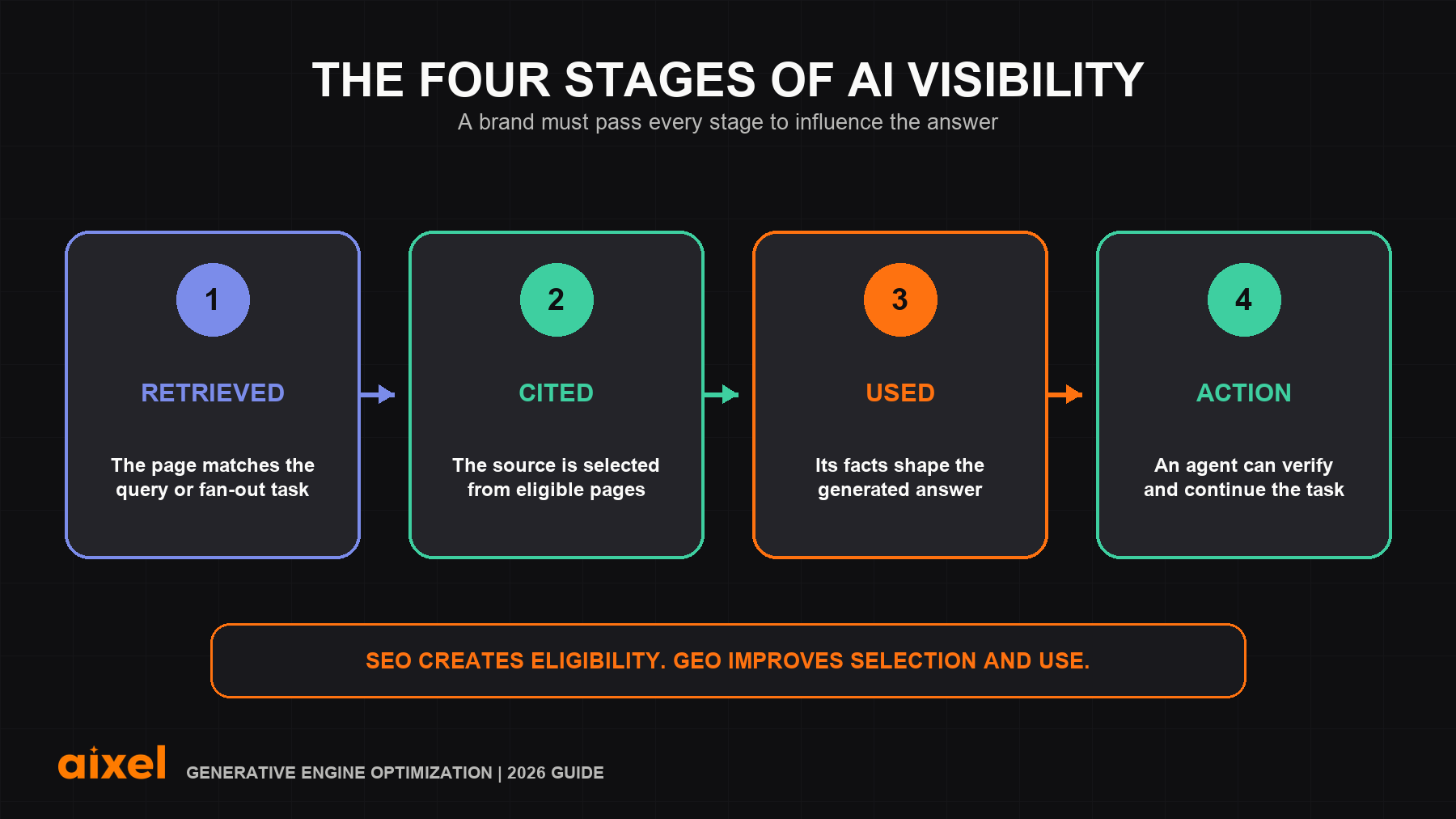
The four stages of AI visibility: retrieval, citation, answer use and agent action.
Stage 1: Retrieval
Can the system find a page that is relevant to the prompt or one of its fan-out queries?
Stage 2: Citation selection
When several relevant pages are available, does the system choose the brand's page as a supporting source?
Stage 3: Answer absorption
Does the final answer actually use the brand's facts, evidence, language or point of view—or is the page merely listed in a citation panel?
Stage 4: Agent action
Can an agent reliably inspect the product, compare the details and complete the next step?
This distinction matters because the fix depends on where visibility fails.
What makes content more likely to be cited?
There is no universal list of “AI ranking factors.” ChatGPT, Google, Copilot, Perplexity and other systems use different models, indexes and retrieval methods. Their answers also change by prompt, location, time and context.
However, platform guidance and current research point to observable content properties that improve eligibility.
A 2026 controlled study, “What Gets Cited”, tested 18 factors across six language models and 252,000 trials. Topical relevance was the strongest content driver. Explicit price information and recent timestamps also helped consistently. Completeness and trust cues produced smaller gains, while formatting changes alone had limited impact.
Another 2026 study separated citation selection from citation absorption. Its analysis found that pages with deeper influence on answers tended to be semantically aligned, well structured and rich in extractable evidence such as definitions, numerical facts, comparisons and procedures. Q&A formatting by itself was not an advantage.
The lesson is sharper than “use more bullets.” AI systems need a strong match and usable evidence. Formatting helps expose the evidence; it does not create it.
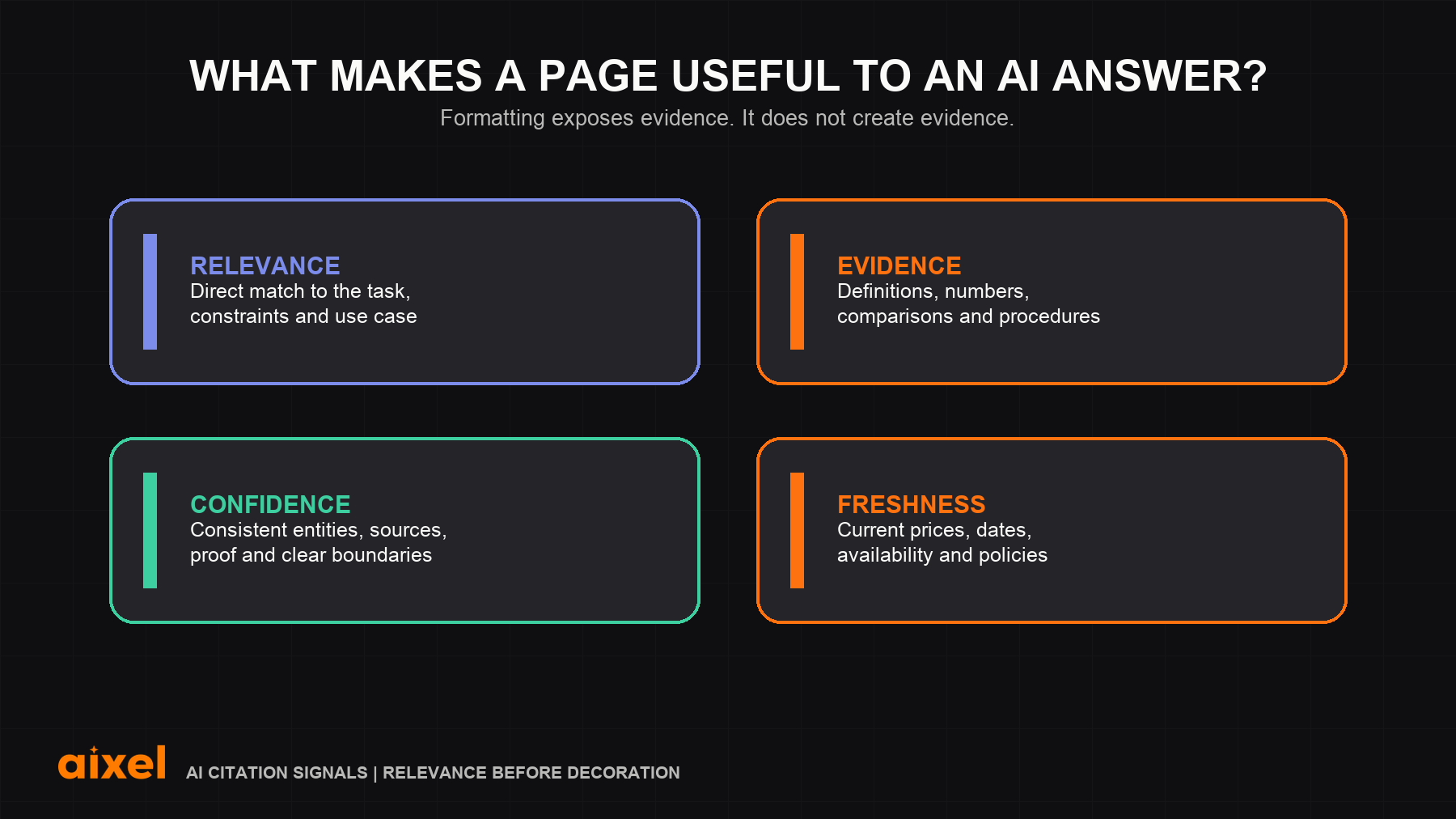
Useful AI-search content combines relevance, evidence, confidence and freshness.
For brands, the most important properties are:
- Topical and task relevance.
- Clear context around every important claim.
- Original, verifiable evidence.
- Complete decision information.
- Consistent brand and product entities.
- Fresh, dated facts.
- Corroboration across credible sources.
- Technical and operational accessibility.
The rest of this guide explains how to build them.
1. Replace the keyword list with a decision map
Keyword research usually begins with phrases and search volume. GEO planning should begin with the decision the customer is trying to make.
For each priority product or service, map six types of questions.
Problem questions
- Why is this problem happening?
- What are the risks of leaving it unresolved?
- Which approaches can solve it?
Category questions
- What type of solution is appropriate?
- How does this category work?
- When is it unnecessary or unsuitable?
Fit questions
- Is it suitable for this company size, region or industry?
- Does it support this technical stack or workflow?
- What requirements must be in place?
Comparison questions
- How does one approach compare with another?
- What are the meaningful trade-offs?
- Which option is best under a specific constraint?
Trust questions
- Is it secure, compliant and reliable?
- What proof supports the claims?
- Who has used it successfully?
Action questions
- What does it cost?
- How long does implementation take?
- What information is needed to start?
- Can the user buy, book, integrate or request a demo?
Then group related questions by the same underlying need. Do not publish a thin page for every wording variation. Google explicitly warns against scaled pages created to capture every fan-out query.
The useful output is not a list of 500 prompts. It is a map of the evidence a buyer—and an AI researching for that buyer—would need to reach a defensible decision.
2. Give every important page one clear job
Many brand pages try to rank for a topic, explain the product, list every feature and convert the visitor at the same time. The result is often vague.
Give each page a primary job:
- Define a category.
- Explain a problem.
- Document a product or integration.
- Prove a use case.
- Compare approaches.
- Present original research.
- Answer a commercial question.
The title, introduction, headings and core evidence should all reinforce that job.
A page about “WhatsApp attribution for real estate” should make the relationship explicit. It should explain the journey, the data that is lost, the systems involved, the implementation requirements and the commercial outcome. A generic attribution page with “real estate” inserted into the title creates a weak semantic match.
Microsoft's guidance on content inclusion in AI answers gives a useful example of specificity: “quiet dishwasher” is vague; “42 dB dishwasher designed for open-concept kitchens” supplies an attribute, measurement and use context. Apply the same principle to brand content.
“Our innovative platform provides powerful analytics for modern businesses.”
“The platform connects website events, ad click identifiers, WhatsApp conversations and CRM outcomes so service businesses can attribute qualified leads after the customer leaves the website.”
The second statement tells a retrieval system what the product is, which entities it connects, who it serves and which problem it solves.
3. Write claim blocks that survive extraction
AI systems may retrieve a passage rather than use the whole page. Important statements should remain accurate when separated from the surrounding copy.
A useful claim block contains four parts:
Claim → context → evidence → boundary
For example:
In a six-month customer implementation, qualified-lead cost fell by 35% after CRM outcomes were returned to Google Ads. The comparison used the same account and conversion definition before and after implementation. The result belongs to this customer and should not be treated as a guaranteed outcome for every advertiser.
This block is stronger than “reduce CAC by 35%” because it explains:
- What changed.
- Which metric was measured.
- Over what period.
- Under what conditions.
- What the result does not prove.
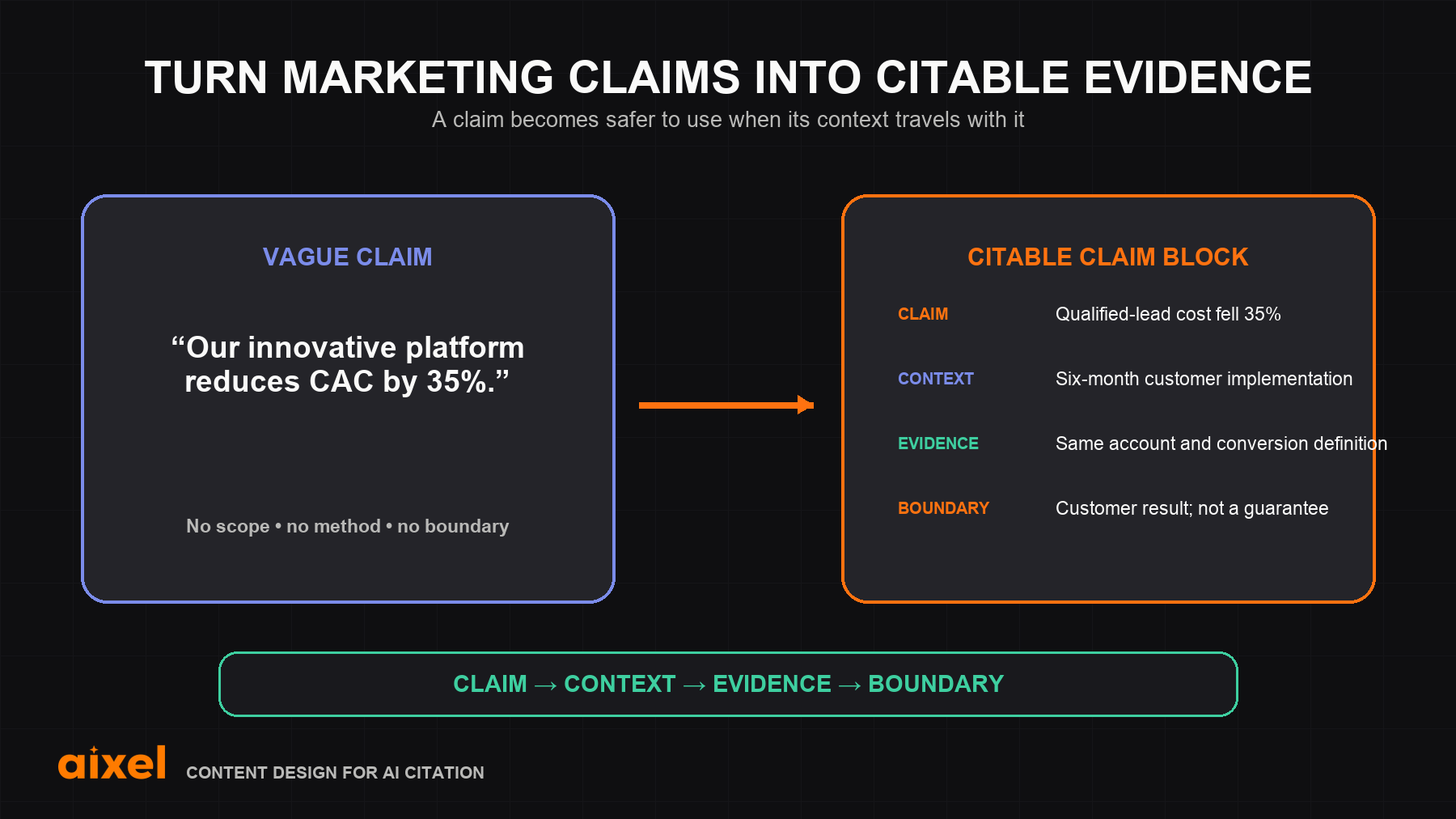
A citable claim keeps its context, evidence and boundary attached.
Review every commercially important page for unsupported adjectives:
Replace the adjective with the observable fact that justifies it.
Instead of “real-time reporting,” state the typical data delay and exceptions. Instead of “works with every CRM,” list supported CRMs and the method used for unsupported systems. Instead of “privacy-first,” explain data collection, retention, consent controls and relevant certifications.
The goal is not dry writing. It is low-ambiguity writing.
4. Increase evidence density, not word count
Longer content is not automatically more useful to an AI system. Google states that there is no ideal page length and no requirement to break pages into artificial “chunks.”
What matters is how much usable, defensible information the page contains.
High-value evidence includes:
- A precise definition.
- A first-party statistic with methodology.
- A product specification.
- An attributed expert explanation.
- A worked example.
- A step-by-step process.
- A comparison with explicit criteria.
- A customer outcome with scope and timeframe.
- A limitation or exception.
- A current price, date or availability status.
Low-value volume includes:
- Repeating the definition in different words.
- A long introduction that delays the answer.
- Generic benefits that apply to every competitor.
- Statistics copied from round-up articles.
- FAQs invented only to repeat keywords.
- AI-generated summaries of information already available elsewhere.
Google's 2026 guidance calls the desired alternative non-commodity content: first-hand, expert-led material that adds something beyond common knowledge.
For a brand, this can come from product and operational reality:
- Anonymized performance benchmarks.
- Implementation patterns seen across customers.
- Failure modes found by support teams.
- Original survey data.
- Before-and-after system diagrams.
- Technical documentation.
- Calculators and decision tools.
- Case studies with a transparent method (see Aixel's Eventia and online pharmacy case studies for this format).
- Clear statements about when the product is not a fit.
The last item is underused. A page that explains its boundaries can be more trustworthy and more useful in a comparison than one that claims universal suitability.
5. Build comparison content around decisions, not competitors
AI search is frequently used to compare options. Most brand comparison pages are poorly equipped for this because they begin with the desired winner and work backwards.
Create comparisons using criteria a buyer would actually apply:
- Ideal customer profile.
- Required integrations.
- Implementation effort.
- Data ownership.
- Pricing model.
- Geographic availability.
- Security or compliance needs.
- Support model.
- Important limitations.
- Time to value.
State where each option fits and where it does not.
“Product A is expensive and difficult. Our product is affordable, simple and powerful.”
“Product A is better suited to teams that need advanced warehouse-native modeling and have dedicated analytics engineers. Our product is better suited to growth teams that need managed ad, CRM and messaging attribution without operating that data infrastructure. Companies that require fully custom transformation logic may prefer the first approach.”
That answer can be used safely because it supplies decision conditions rather than a promotional verdict.
Also publish “alternative approach” content, not only “Brand A vs Brand B.” A buyer may ask whether to use a product, build internally, use an agency or solve the problem through an existing platform. AI systems need evidence for that broader decision.
6. Make brand entities consistent and unambiguous
An AI system may encounter the company on its website, LinkedIn, review platforms, partner directories, news articles, customer pages and public databases. Conflicting descriptions increase uncertainty.
Create a canonical entity sheet for internal use:
- Legal and trading name.
- Product names and categories.
- One-sentence product definition.
- Founding date and headquarters.
- Markets and locations served.
- Core audience.
- Supported integrations.
- Pricing model.
- Approved proof points.
- Security and compliance facts.
- Official social and business profiles.
- Current leadership and expert spokespeople.
Use those facts consistently across high-authority owned profiles. Keep old positioning and retired product names from lingering on forgotten pages.
Appropriate structured data can reinforce visible information, but it does not create authority on its own. Use `Organization`, `Product`, `SoftwareApplication`, `LocalBusiness`, `Person`, `Article` and other relevant types only when they match the page.
The rule is simple: The website, markup, feeds, profiles and third-party descriptions should not tell five different versions of the company story.
7. Create corroboration beyond the brand's website
Owned content explains what the company says about itself. AI systems can also retrieve what customers, experts, partners, publishers and communities say about it.
Brands should build an evidence distribution program, not a mention-buying program.
Useful third-party signals include:
- Detailed reviews from real customers.
- Customer case studies published on the customer's domain.
- Partner and integration listings.
- Expert commentary in reputable industry publications.
- Original research cited by journalists and analysts.
- Accurate company profiles in relevant databases.
- Conference talks, webinars and video transcripts.
- Helpful participation in professional communities.
- Product documentation referenced by developers or practitioners.
Avoid mass directory submissions, fabricated reviews, paid listicles with no disclosure and forum posts created to imitate customer discussion. Google explicitly warns that inauthentic mentions are not a useful long-term strategy.
The practical process is:
- Run priority prompts and record which third-party domains are cited.
- Group them by source type: publishers, reviews, communities, documentation, video or databases.
- Determine why those sources are useful for the query.
- Create evidence worth covering or contribute real expertise where appropriate.
- Correct inaccurate profiles and stale third-party facts.
The objective is not to repeat the brand name everywhere. It is to make independent, credible sources associate the brand with the right category, use case and proof.
8. Treat freshness as a content operation
Recent timestamps and explicit prices improved citation selection in the 2026 controlled study. That does not mean changing a date without changing the page. It means current information reduces uncertainty for time-sensitive questions.
Every important page should have an owner and a review trigger. Update when:
- A price or plan changes.
- An integration launches or is retired.
- A product feature changes.
- A regulation or platform policy changes.
- Availability changes.
- New benchmark data replaces old data.
- A named executive or expert changes.
- A competitor comparison becomes inaccurate.
Show a meaningful “last reviewed” or “last updated” date where it helps the reader. Keep the original publication date when editorial history matters. Explain material updates for high-value research or guides.
For fast-changing websites, use sitemaps and IndexNow where supported. Keep ecommerce feeds, Google Merchant Center, Google Business Profile and Bing Places aligned with the website.
Freshness is not a date stamp. It is agreement between the current business and the information available about it.
9. Make visual, video and PDF evidence machine-accessible
AI search is multimodal, but critical facts should not exist only inside a chart, video, webinar or PDF.
For important assets:
- Add descriptive titles and captions.
- Provide accurate alt text where appropriate.
- Publish a transcript for substantive video or audio.
- Explain the takeaway from a chart in HTML text.
- Include the data source and methodology near the visual.
- Give the asset a stable, crawlable page.
- Put core product and policy information in HTML, even when a PDF version exists.
Google can surface images and video in generative search. Microsoft cautions against hiding core information only in images, tabs or PDFs because it can make reliable extraction harder.
A webinar can therefore become several useful evidence surfaces: the video, transcript, speaker profile, key findings, charts and a referenced article. The substance stays the same; its accessibility improves.
10. Prepare the website for action agents
Citation visibility is the current battleground. Agent usability is the next one.
Browser agents may use the visual page, DOM and accessibility tree to understand and operate a site. Brands should test whether important tasks remain clear without relying on human guesswork.
For an agent-friendly path:
- Use descriptive labels for buttons and fields.
- Associate form labels correctly with inputs.
- Keep navigation and page hierarchy predictable.
- Make prices, availability and policies explicit.
- Avoid critical actions that depend only on hover or ambiguous icons.
- Provide clear success and error states.
- Keep product variants and identifiers consistent.
- Make booking, quote and checkout requirements visible before the final step.
- Use structured product and merchant data where relevant.
- Maintain reliable APIs and feeds when the business model supports them.
- Monitor emerging standards such as the Universal Commerce Protocol when relevant.
Do not weaken security controls to accommodate agents. Authentication, consent, payment approval, rate limits and fraud controls still apply.
The strategic question is: Can a system verify that the offering fits, determine the current terms and complete the permitted next step without inventing missing information?
11. Fix the technical layer that makes all of this retrievable
GEO does not bypass technical SEO. Google says its generative search experiences are rooted in its core search and quality systems.
Check that priority content is:
- Publicly accessible where intended.
- Allowed by robots.txt and CDN rules.
- Indexable and eligible for snippets.
- Linked from relevant pages.
- Included in an accurate sitemap.
- Assigned the correct canonical URL.
- Available in rendered HTML.
- Not duplicated across several near-identical URLs.
- Fast and usable across devices.
- Supported by structured data that matches visible content.
Google does not require `llms.txt`, special AI markup or artificial content chunking for visibility in its generative search features. Other services may choose to use different files or protocols, but they should not distract from the retrieval foundation.
Technical clarity creates eligibility. It does not guarantee citation. The content and evidence layers determine whether an eligible page is useful enough to select.
12. Measure visibility as a probability, not a fixed ranking
AI answers are non-deterministic. The same prompt can produce different brands and sources at different times.
A 2026 study on uncertainty in AI visibility found substantial citation variability across repeated samples and warned that single-run measurements can create misleading precision.
Do not report “we rank number two in ChatGPT” from one screenshot. Build a measurement system around repeated prompt groups.
Track:
- Mention rate: how often the brand appears.
- Citation rate: how often an owned page is cited.
- Citation share: the brand's citations relative to defined competitors.
- Answer absorption: whether the brand's facts or evidence shape the answer.
- Recommendation rate: how often the brand enters a shortlist.
- Accuracy: whether product, pricing and fit are represented correctly.
- Source mix: owned, earned, review, community and other domains shaping the answer.
- Prompt coverage: awareness, category, fit, comparison, trust and action questions.
- AI referral quality: engagement, leads and revenue from identifiable AI sources.
- Assisted influence: self-reported AI discovery and CRM evidence where direct referral data is unavailable.
Use several prompt variants, repeat tests over time and separate results by engine. A change within normal response variance is not *necessarily* an improvement.
Microsoft's AI Performance reporting in Bing Webmaster Tools can show citations, cited URLs and sampled grounding queries across supported experiences. Google began testing dedicated generative AI performance reports in Search Console in June 2026. Combine platform data with repeated prompt testing and business outcomes.
A 90-day GEO operating plan
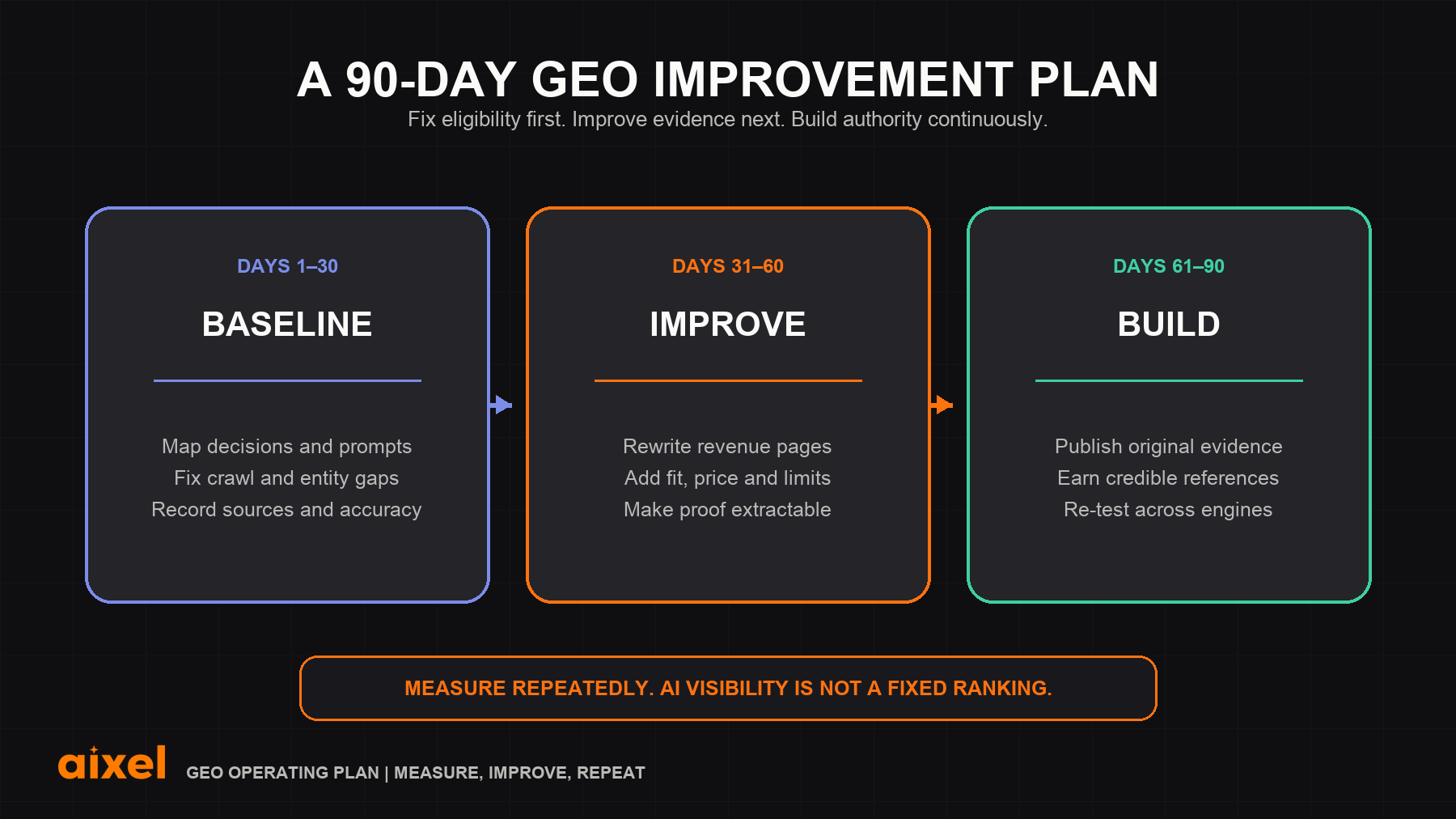
A 90-day operating plan: establish the baseline, improve revenue pages and build evidence.
Days 1–30: Establish the evidence baseline
- Define the highest-value customer decisions.
- Build prompt groups across the six question types.
- Test relevant AI engines repeatedly.
- Record mentions, citations, accuracy and competitor sources.
- Fix crawling, indexation, canonical and rendering problems.
- Create the canonical brand entity sheet.
- Correct inconsistent product and company facts.
Days 31–60: Improve the pages closest to revenue
- Rewrite vague product and solution descriptions with specific context.
- Add pricing logic, implementation requirements, integrations and limitations.
- Convert unsupported claims into claim-context-evidence-boundary blocks.
- Improve comparison pages using real decision criteria.
- Put critical PDF, video and image information into accessible HTML.
- Consolidate thin or duplicate pages.
- Add meaningful review dates and content owners.
Days 61–90: Build the evidence moat
- Publish one original research, benchmark or operational insight asset.
- Turn real customer outcomes into methodologically clear case studies.
- Improve partner and integration listings.
- Earn relevant third-party coverage around useful evidence.
- Test booking, quote, product and checkout journeys for agent accessibility.
- Re-run the prompt set and compare results over multiple samples.
- Connect AI referrals and self-reported discovery to qualified outcomes.
The program should then repeat. Products change, competitors publish, sources gain or lose authority and AI systems evolve.
What brands should stop doing in 2026
- Stop publishing generic summaries that an AI system can produce without the brand.
- Stop creating one thin page for every long-tail prompt.
- Stop treating a date change as a content update.
- Stop describing products with adjectives instead of facts.
- Stop hiding prices, limitations and implementation requirements until the sales call.
- Stop building comparison pages that no independent buyer would trust.
- Stop measuring AI visibility from one prompt run.
- Stop buying low-quality mentions to imitate authority.
- Stop expecting schema or `llms.txt` to compensate for weak evidence.
- Stop optimizing only the website while ignoring reviews, partners, communities and public profiles.
The practical GEO standard
A brand is well prepared for AI search when a system can answer five questions with confidence:
- What exactly is this company or product?
- Which customer and problem is it relevant to?
- What verifiable evidence supports its claims?
- When should it—and should it not—be recommended?
- Can the customer or agent take the next step reliably?
That is what improves AI visibility in 2026: not more content, but more usable context; not louder claims, but stronger evidence; not scattered mentions, but consistent and credible signals.
Traditional SEO still gets the page into the retrieval system. GEO makes the information worth selecting, citing and using. Agent readiness makes the business possible to act on.
Brands that align those layers will be easier to discover at the moment a customer asks, easier to defend in a comparison and easier to choose when AI becomes part of the decision.
Frequently asked questions
Is GEO different from SEO?
GEO extends SEO rather than replacing it. Technical SEO, indexation, relevance and content quality help a page enter the retrieval set. GEO adds a focus on whether the page supplies clear, verifiable information that can be selected, cited and used inside a generated answer.
What should a brand change first for AI visibility?
Start with high-value product, solution and comparison pages. Replace vague positioning with explicit audience, use-case, integration, pricing, implementation and limitation information. Then support the important claims with original evidence and consistent third-party corroboration.
Do schema or llms.txt guarantee AI citations?
No. Google states that it does not require special AI markup or `llms.txt` for its generative search features. Valid structured data can still help search systems understand eligible page types and rich-result information when it matches the visible page, but it does not guarantee selection or citation.
How long does GEO take to work?
There is no fixed period. Technical corrections can be processed after a platform recrawls the page. Content, authority and reputation changes usually require repeated publication, discovery and re-evaluation. Measure over several runs and dates because AI answers vary.
Can a company guarantee placement in ChatGPT, AI Mode or Perplexity?
No. These are third-party, probabilistic systems. A credible GEO program improves discovery, clarity, evidence and measured inclusion; it cannot control the final generated answer.
How should GEO performance be measured?
Track repeated mention rate, citation rate, recommendation rate, answer accuracy, cited pages and competitor source share across a stable prompt set. Combine this with AI referral traffic, self-reported discovery and qualified conversion outcomes.
Ready to recover your attribution signal?
Connect Meta, Google, TikTok, and WhatsApp in one platform. No code required.
Get started free
